I-DNTITI: Building the Carbon Intelligence Layer for Industrial Net-Zero Transition
Carbon accounting is often perceived as a reporting exercise.
In reality, it is a data interpretation challenge at scale.
Industrial organizations today are not struggling with the absence of data — they are struggling with:
- Fragmented and unstructured activity data.
- Complex emission factor selection.
- Lack of traceability and audit-ready systems.
This creates a critical gap between ESG reporting requirements and the ability to produce accurate, decision-grade emissions insights.
The “𝗜-𝗗𝗡𝗧𝗜𝗧𝗜: 𝗜𝗻𝘁𝗲𝗿𝗮𝗰𝘁𝗶𝘃𝗲 𝗗𝗶𝗴𝗶𝘁𝗮𝗹-𝗵𝘂𝗯 𝗳𝗼𝗿 𝗡𝗲𝘁-𝘇𝗲𝗿𝗼 𝗧𝗿𝗮𝗻𝘀𝗶𝘁𝗶𝗼𝗻 𝗮𝗻𝗱 𝗜𝗻𝗰𝗹𝘂𝘀𝗶𝗼𝗻 𝘁𝗼𝘄𝗮𝗿𝗱𝘀 𝗧𝗿𝗮𝗻𝘀𝗳𝗼𝗿𝗺𝗮𝘁𝗶𝘃𝗲 𝗜𝗻𝗱𝘂𝘀𝘁𝗿𝘆” program was developed as a direct response to this gap.
From Research to Industrial Reality
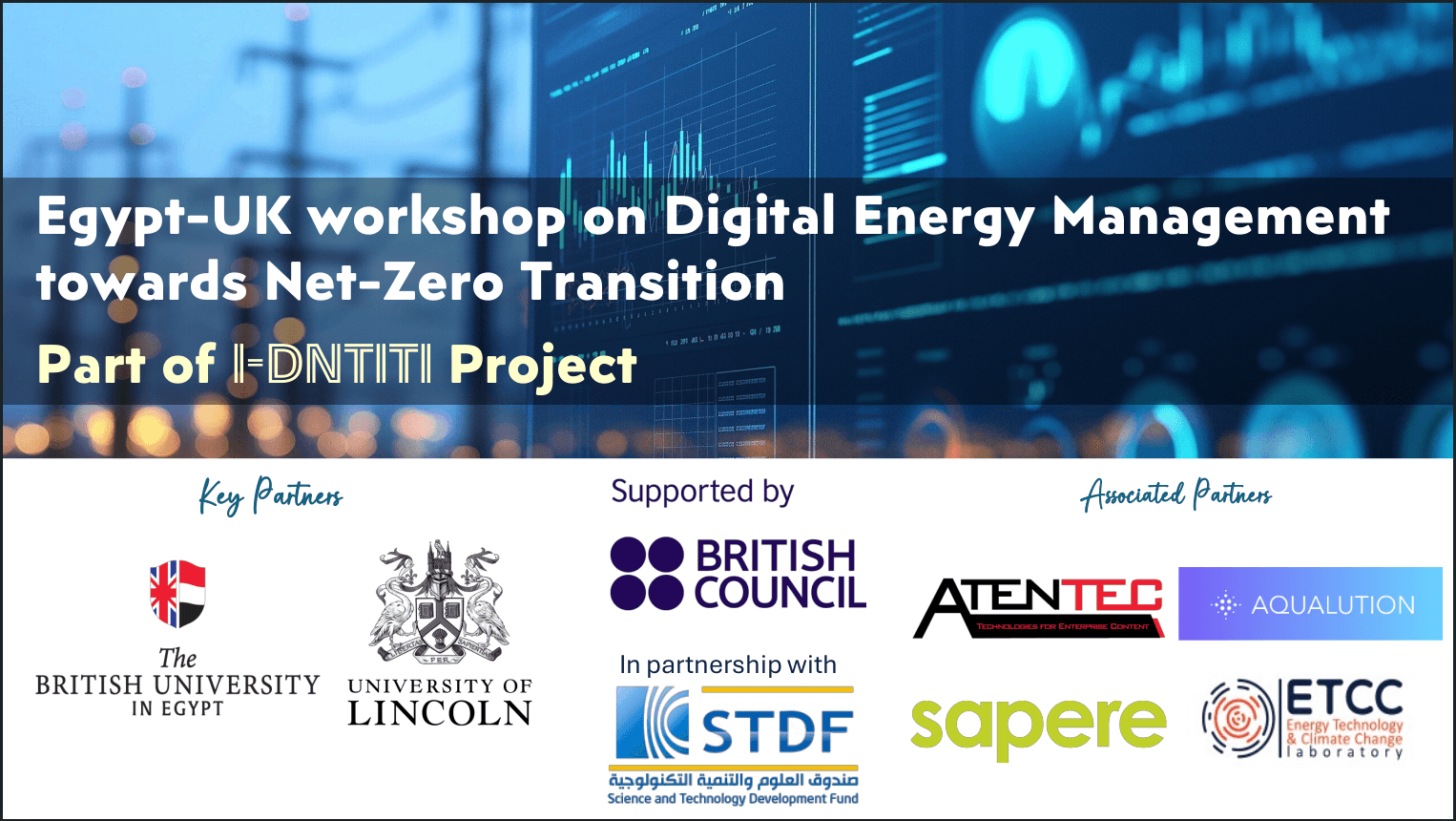
I-DNTITI is a collaborative initiative led by The British University in Egypt and the University of Lincoln.
However, the program goes beyond traditional academic collaboration.
It represents an applied research model, where:
- Theoretical frameworks are tested against real industrial scenarios
- Methodologies are validated through direct engagement with manufacturing sectors
- Solutions are designed with deployment in mind
Through workshops, industry participation, and factory-level exposure, the program ensures that its outputs are grounded in practical complexity, not theoretical assumptions.
The Core Challenge: Industrial Carbon Data
The central problem I-DNTITI addresses is not emissions calculation itself — but the process leading to it.
Key challenges include:
- Integrating data from multiple operational sources.
- Structuring unstandardized activity data.
- Mapping activities to accurate emission factors.
- Ensuring consistency across large-scale datasets.
Without solving these layers, carbon reporting becomes unreliable, and ESG compliance becomes high-risk.
A Carbon Intelligence Infrastructure — Not Just a Platform
I-DNTITI should not be understood as a standalone software solution.
It is better defined as a:
Hybrid Carbon Intelligence Infrastructure for Industrial Net-Zero Transition
This infrastructure operates across three tightly integrated layers:
1. Data Layer
- Aggregation of industrial activity data from diverse systems.
- Data cleaning, normalization, and structuring.
- Handling unstructured and large-scale datasets.
2. Intelligence Layer
- CO₂e calculation using validated methodologies.
- Intelligent emission factor matching.
- Forecasting and predictive analytics.
- What-if scenario modeling for decision evaluation.
3. Decision Support Layer
- Enabling data-driven decarbonization strategies.
- Supporting operational and strategic planning.
- Bridging technical outputs with business decisions.
The Role of AtenTEC: Enabling the Intelligence Engine
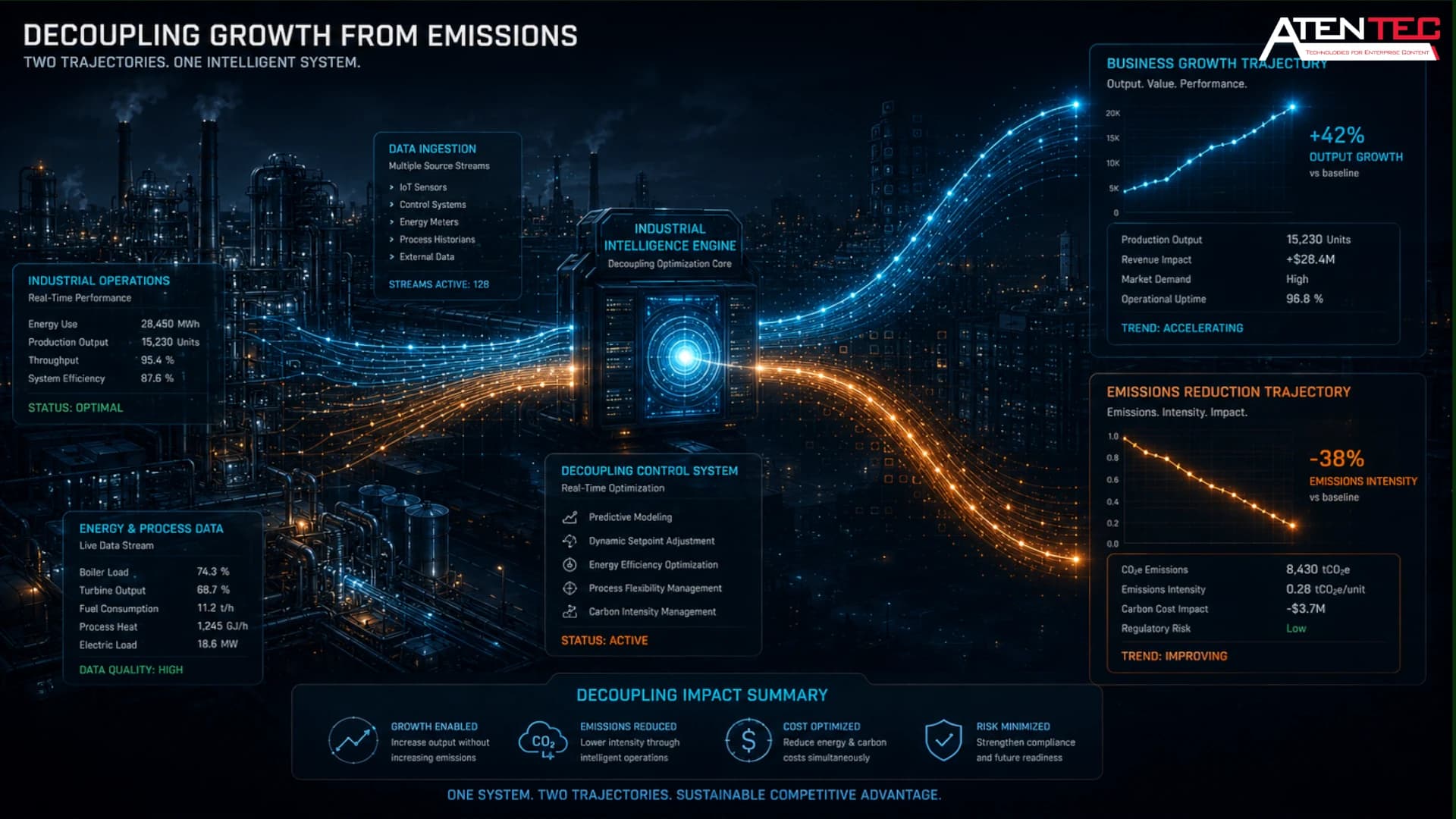
Within I-DNTITI, AtenTEC serves as the core technology enabler, responsible for translating research complexity into deployable systems.
Its contribution spans the full carbon intelligence workflow:
- Designing systems for data ingestion and refinement across industrial environments.
- Developing a high-dimensional decision engine capable of processing large-scale energy datasets.
- Enabling rapid analysis of multi-million activity records with high-confidence outputs.
- Supporting CO₂e forecasting, benchmarking, and what-if scenario analysis.
- Contributing to the consultation and matchmaking layer, connecting organizations with domain experts.
This role ensures that the system moves beyond theoretical modeling into real-time, decision-ready intelligence.
Hybrid Architecture as an Enabler
To address industrial concerns around data sensitivity and scalability, I-DNTITI adopts a hybrid architecture:
- Sensitive operational data remains on-premise.
- Advanced analytics and modeling are delivered through cloud-based engines.
This approach balances:
- Data sovereignty.
- Performance scalability.
- Security and compliance requirements.
Alignment with ESG and Compliance Frameworks
A key strength of I-DNTITI is its alignment with global sustainability and compliance standards.
The system is designed to support:
- GHG Protocol for emissions accounting.
- ESG reporting requirements.
- Traceability and auditability of emissions data.
- Carbon footprint monitoring and reporting.
Additionally, it contributes to organizational readiness for frameworks such as:
- CPAM (Certified Professional in Asset Management).
- ISO 55000 for asset management.
By embedding these principles into the system design, I-DNTITI enables organizations to move toward audit-ready, compliance-aligned operations.
Industrial Impact
The value of I-DNTITI is most evident in complex industrial environments, where:
- Data volumes are high.
- Operations are interconnected.
- Decision-making carries significant financial and regulatory implications.
Key outcomes include:
- More reliable emissions reporting.
- Reduced risk of misclassification and compliance errors.
- Enhanced ability to plan and evaluate decarbonization strategies.
- Improved confidence in ESG disclosures.
From Data to Decisions
The transition to net-zero is not limited by ambition — it is limited by the ability to understand and act on data.
I-DNTITI addresses this challenge by building the carbon intelligence layer required for modern industry.
By integrating:
- Academic research.
- Industrial validation.
- Advanced data and decision systems.
the program establishes a practical model for how organizations can move from:
fragmented data → to structured insight → to informed action
And ultimately, toward credible and achievable net-zero transformation.