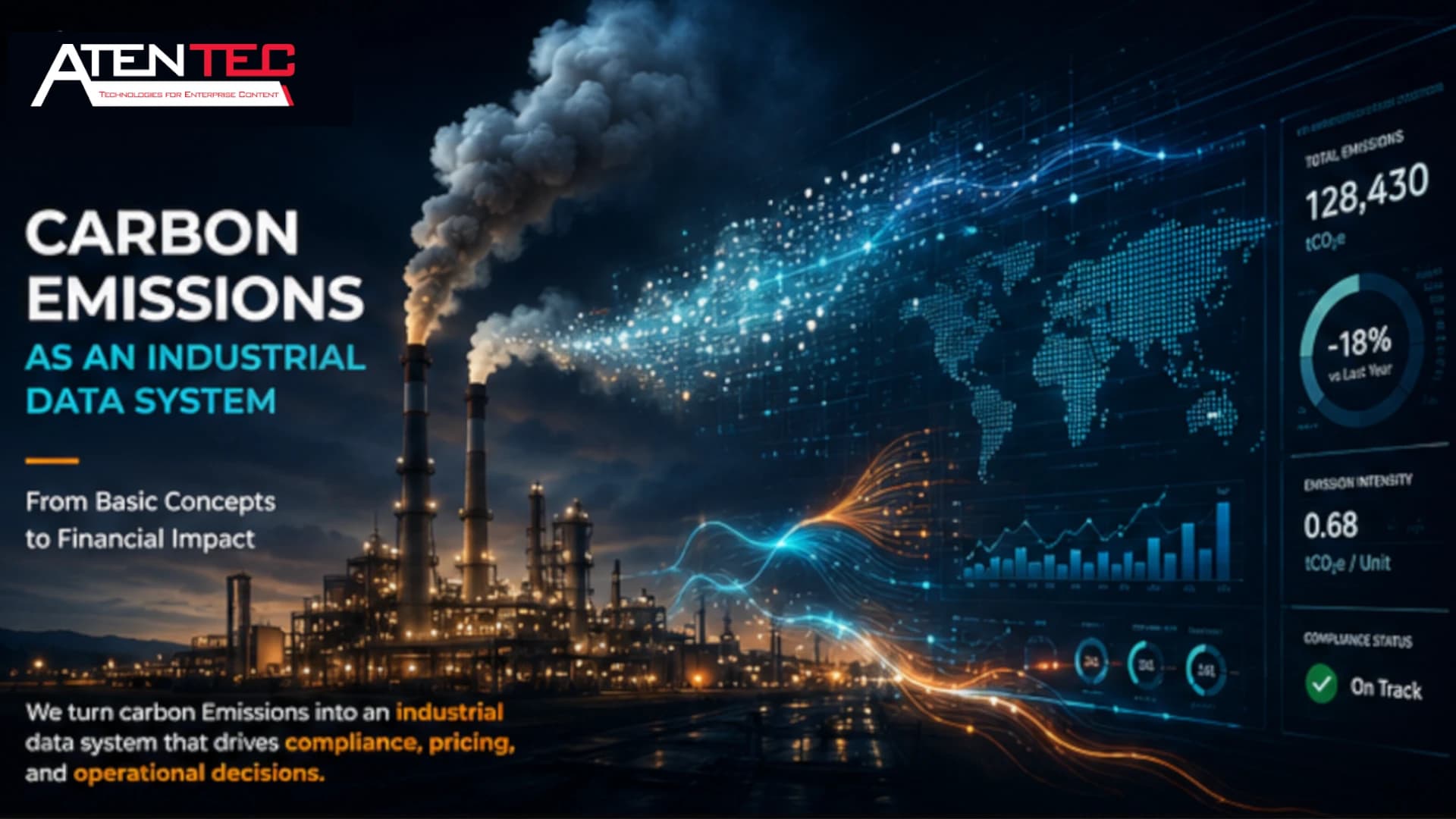
Carbon Emissions as an Industrial System
From Basic Concepts to Financial Impact
In most business conversations today, carbon emissions are still framed as a sustainability metric—a number to be calculated, reported, and eventually reduced. This framing, while convenient, is fundamentally incomplete.
The fact is: What organizations are actually dealing with is not a number, but a system.
A system where operational activity, data uncertainty, regulatory pressure, financial exposure, and strategic decision-making are deeply interconnected. Yet, most approaches to carbon management still treat each of these elements in isolation.
This article introduces a different perspective.
Carbon emissions are not an environmental metric—they are an industrial data system.
And the organizations that recognize this shift early will be the ones capable of navigating compliance, controlling costs, and making informed operational decisions in an increasingly carbon-constrained economy.
The Illusion of Simplicity
For all beginners in this field, there is a clear sense of surprise: Is the subject really that complicated? The internal answer is, "I don't think so," However, upon taking the first real step in the field, they realize the extent of the complexity and the obstacles that the calculations and the process as a whole face.
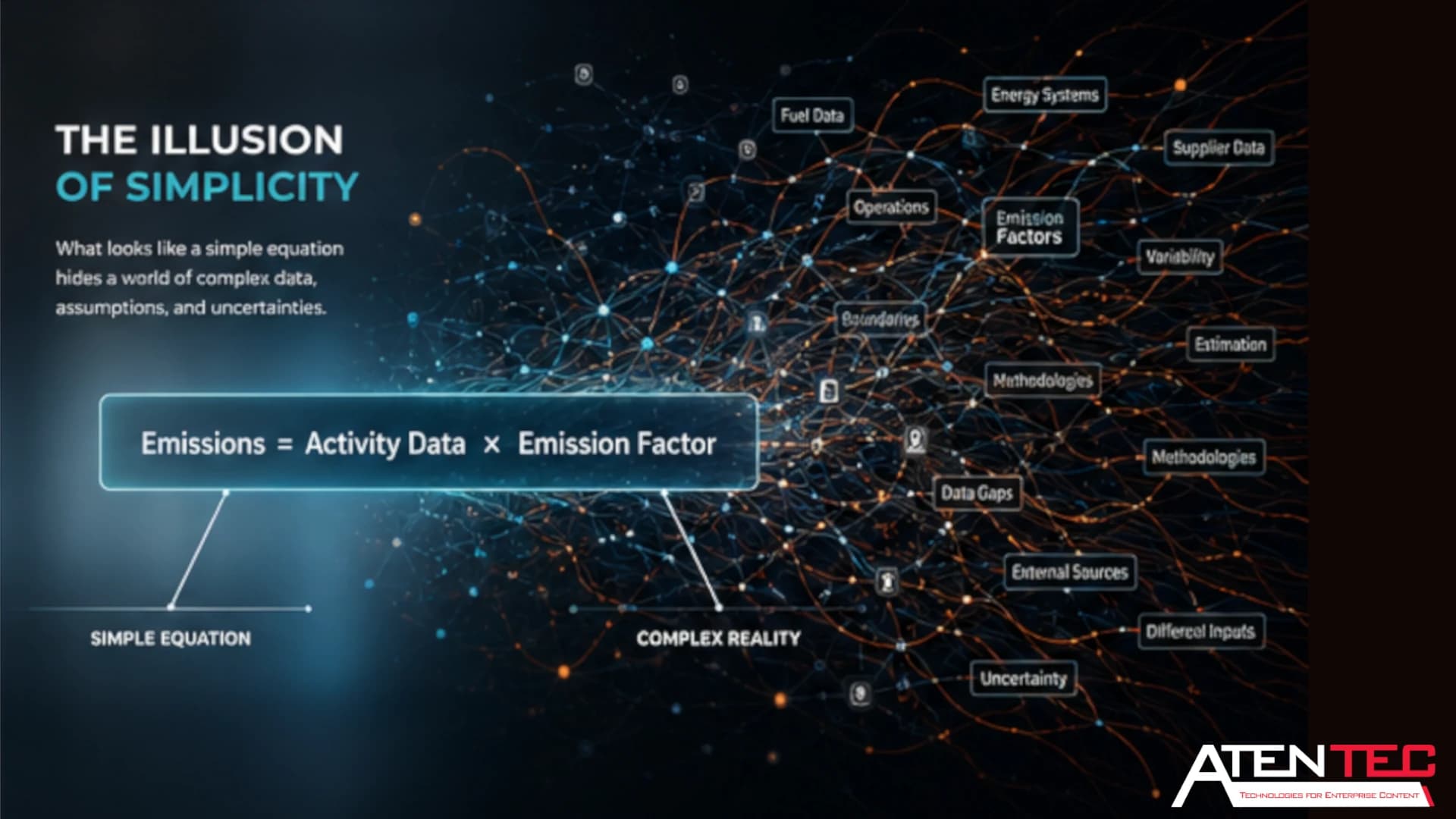
At its most basic representation, carbon emissions appear straightforward. Activity data is multiplied by emission factors, producing a measurable output. This simplicity has shaped how companies approach carbon accounting for years.
Emissions = Activity\ Data \times Emission\ Factor
However, this equation hides more than it reveals.
Activity data is rarely complete or consistent. It is fragmented across departments, systems, and even external partners. Emission factors, often treated as constants, vary depending on geography, methodology, and data source. The result is not a precise measurement, but a constructed estimate—one that depends heavily on assumptions.
In practice, companies are not calculating emissions. They are interpreting imperfect data under uncertain conditions.
Carbon as a Multi-Layered System
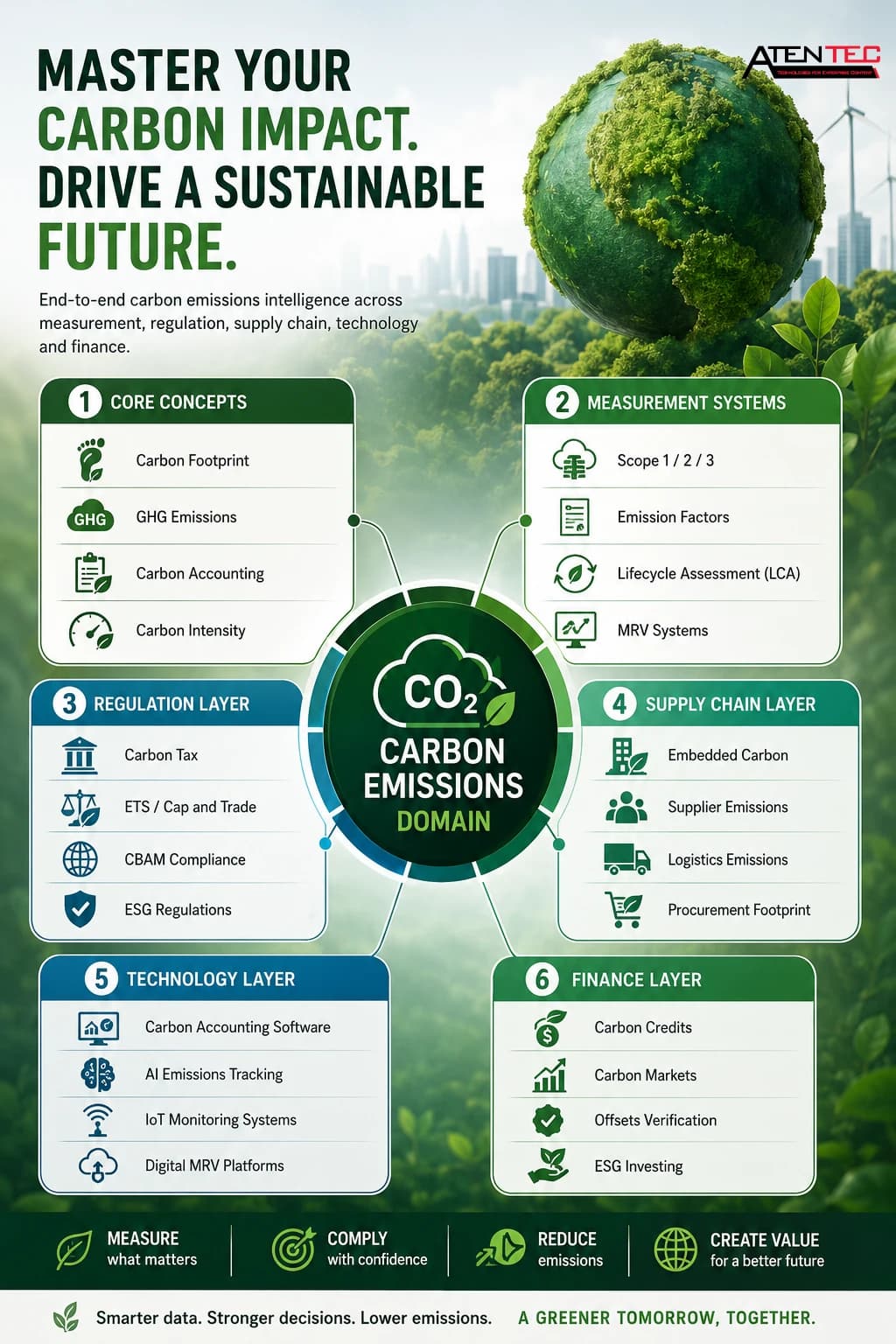
To understand carbon emissions in a meaningful way, it is necessary to move beyond isolated calculations and examine the full structure in which they exist.
Carbon operates across multiple interconnected layers:
1. Core Concepts: The Foundation That Is Often Misunderstood
At the base level, concepts such as carbon footprint, greenhouse gas emissions, carbon accounting, and carbon intensity form the language of the domain. Yet these concepts are frequently oversimplified.
A carbon footprint, for instance, is not a single number but a composite representation shaped by system boundaries, data sources, and methodological choices. Similarly, greenhouse gas emissions extend beyond carbon dioxide to include gases with varying global warming potentials, introducing additional layers of abstraction.
Even carbon intensity—often used in decision-making—depends on how output is defined and measured.
Without a precise understanding of these concepts, every subsequent layer becomes unstable.
2. Measurement Systems: Where Theory Meets Data Reality
The second layer introduces structure through frameworks such as Scope 1, Scope 2, and Scope 3 emissions, emission factors, lifecycle assessments (LCA), and monitoring, reporting, and verification (MRV) systems.
These frameworks attempt to standardize measurement, but they also expose the inherent complexity of the process.
Scope 3 emissions, for example, extend beyond organizational boundaries into supply chains, where data is often incomplete or unavailable. Lifecycle assessments attempt to capture total impact but rely heavily on assumptions and generalized datasets. MRV systems aim to ensure accuracy, yet verification itself becomes a challenge when underlying data lacks consistency.
The gap between theoretical models and real-world data becomes increasingly evident at this stage.
3. Regulation Layer: From Sustainability to Compliance Pressure
Carbon is no longer a voluntary reporting exercise. It is rapidly becoming a regulated domain with direct financial consequences.
Mechanisms such as carbon taxes, emissions trading systems (ETS), the Carbon Border Adjustment Mechanism (CBAM), and ESG reporting frameworks are redefining how companies interact with emissions data.
Under these systems, inaccuracies are not just technical issues—they translate into financial penalties, market disadvantages, and compliance risks.
A miscalculated emission value can directly affect how much a company pays, how it is regulated, and how it competes in international markets.
4. Supply Chain Layer: The Expansion of the Problem
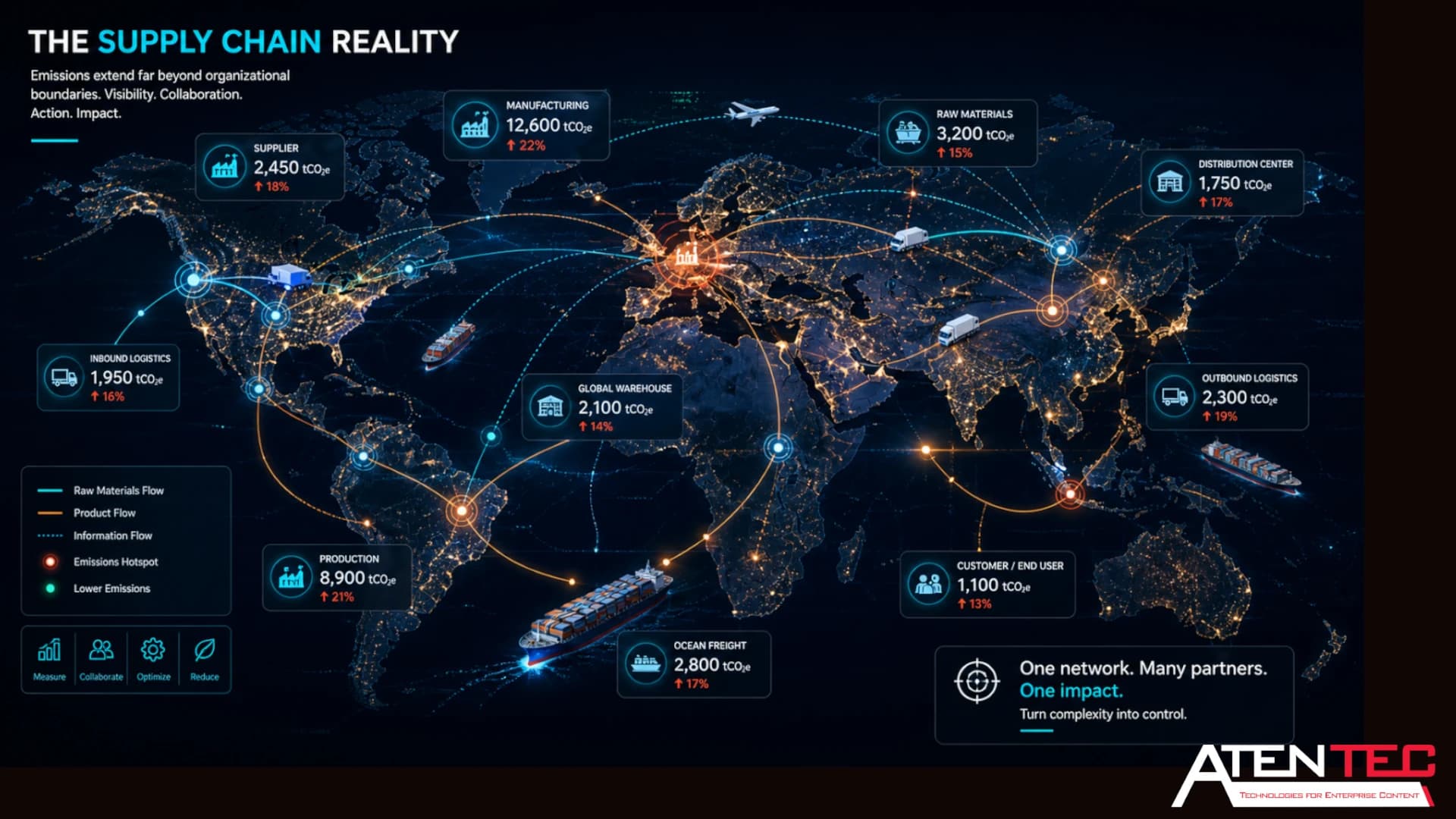
One of the most significant shifts in carbon management is the realization that the majority of emissions often lie outside direct organizational control.
Embedded carbon in products, supplier emissions, logistics operations, and procurement decisions all contribute to the overall carbon profile.
This introduces a new level of complexity.
Companies must now rely on external data, coordinate with multiple stakeholders, and operate within a network where visibility is limited and control is partial. The problem is no longer internal—it is systemic.
5. Technology Layer: The Missing Operational Backbone
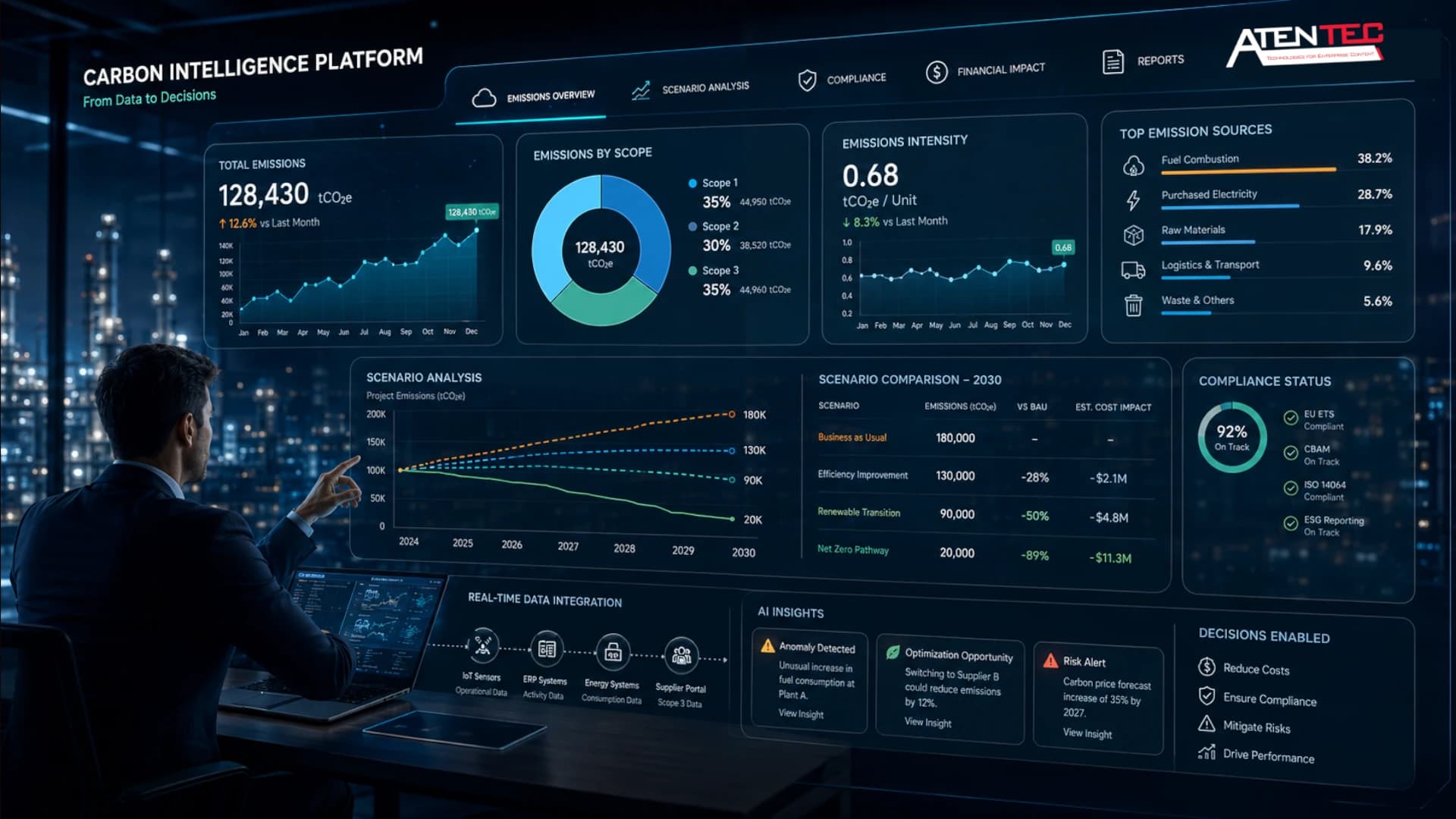
As complexity increases, traditional tools such as spreadsheets and static reporting systems become insufficient.
Organizations require systems capable of:
- Integrating data from multiple sources.
- Continuously updating emission factors.
- Tracking emissions in near real-time.
- Supporting scenario modeling and forecasting.
This is where digital platforms, AI-driven analytics, IoT monitoring systems, and advanced carbon accounting software emerge—not as optional enhancements, but as operational necessities.
Without a technological backbone, the system cannot function effectively.
6. Finance Layer: Where Carbon Becomes a Strategic Variable
At the highest level, carbon transitions from an environmental concern to a financial variable.
Carbon credits, carbon markets, offset mechanisms, and ESG-driven investment decisions all contribute to the monetization of emissions.
Here, emissions directly influence:
- Cost structures.
- Pricing strategies.
- Investment decisions.
- Risk exposure.
A company’s carbon profile becomes a factor in its financial performance and market valuation.
The Critical Gap: Fragmentation
Despite the existence of all these layers, most organizations approach them independently.
- Concepts are understood in isolation.
- Measurements are treated as static calculations.
- Regulations are handled reactively.
- Supply chains are only partially integrated.
- Technology is applied in silos.
- Financial implications are considered too late.
⚠️ The result is fragmentation.
And fragmentation is the core reason why companies struggle to translate carbon data into actionable decisions.
A Different Approach: Carbon as an Industrial Data System
To overcome this fragmentation, a shift in perspective is required.
Carbon must be treated not as a reporting output, but as an integrated system that connects:
- Data inputs.
- Operational processes.
- Regulatory frameworks.
- Financial outcomes.
This is the foundation of a new model:
We turn carbon emissions into an industrial data system that drives compliance, pricing, and operational decisions.
In this model:
- Emissions are continuously interpreted, not periodically calculated.
- Data is integrated across internal and external sources.
- Scenarios are modeled before decisions are made.
- Financial impact is embedded into operational planning.
This transforms carbon from a passive metric into an active decision variable.
Structure of This Knowledge Series
This article serves as the primary pillar for the entire Carbon Emissions Domain.
Each of the six layers introduced here will be expanded into its own dedicated pillar article, followed by a series of detailed cluster articles addressing individual topics.
The structure will be as follows:
- Each layer will have a comprehensive pillar article exploring its strategic dimension
- Each topic within the layer will be developed into a focused article providing in-depth analysis
Over time, this will form a connected knowledge system, where each article builds on the previous one, creating a complete and integrated understanding of carbon as an industrial domain.
Links to all articles will be added progressively as they are published.
So
What appears to be a simple equation is, in reality, a complex and evolving system.
Organizations that continue to treat carbon emissions as a static metric will face increasing challenges in compliance, cost control, and operational efficiency.
Those that recognize carbon as a structured data system—one that must be interpreted, managed, and integrated into decision-making—will gain a significant advantage.
Because the real question is no longer:
How much do we emit?
But rather:
How do we use emissions data to drive better decisions?
,And that is where the real transformation begins.
You can know more about I-DNTITI “𝗜-𝗗𝗡𝗧𝗜𝗧𝗜: 𝗜𝗻𝘁𝗲𝗿𝗮𝗰𝘁𝗶𝘃𝗲 𝗗𝗶𝗴𝗶𝘁𝗮𝗹-𝗵𝘂𝗯 𝗳𝗼𝗿 𝗡𝗲𝘁-𝘇𝗲𝗿𝗼 𝗧𝗿𝗮𝗻𝘀𝗶𝘁𝗶𝗼𝗻 𝗮𝗻𝗱 𝗜𝗻𝗰𝗹𝘂𝘀𝗶𝗼𝗻 𝘁𝗼𝘄𝗮𝗿𝗱𝘀 𝗧𝗿𝗮𝗻𝘀𝗳𝗼𝗿𝗺𝗮𝘁𝗶𝘃𝗲 𝗜𝗻𝗱𝘂𝘀𝘁𝗿𝘆” program, and follow this article updates for the detailed articles.
Carbon Emissions as an Industrial System
│
├── 1. Core Concepts Up next
│ ├── carbon footprint Upcoming
│ ├── GHG emissions Upcoming
│ ├── carbon accounting Upcoming
│ └── carbon intensity Upcoming
│
├── 2. Measurement Systems Upcoming
│ ├── Scope 1 / 2 / 3 Upcoming
│ ├── emission factors Upcoming
│ ├── lifecycle assessment (LCA) Upcoming
│ └── MRV systems (Upcoming)
│
├── 3. Regulation Layer (Upcoming)
│ ├── carbon tax (Upcoming)
│ ├── ETS / cap and trade (Upcoming)
│ ├── CBAM compliance (Upcoming)
│ └── ESG regulations (Upcoming)
│
├── 4. Supply Chain Layer (Upcoming)
│ ├── embedded carbon (Upcoming)
│ ├── supplier emissions (Upcoming)
│ ├── logistics emissions (Upcoming)
│ └── procurement footprint (Upcoming)
│
├── 5. Technology Layer (Upcoming)
│ ├── carbon accounting software (Upcoming)
│ ├── AI emissions tracking (Upcoming)
│ ├── IoT monitoring systems (Upcoming)
│ └── digital MRV platforms (Upcoming)
│
└── 6. Finance Layer (Upcoming)
├── carbon credits (Upcoming)
├── carbon markets (Upcoming)
├── offsets verification (Upcoming)
└── ESG investing (Upcoming)