Carbon Tax in Manufacturing: How Process Data Becomes a Tax Exposure, The tax is not calculated from a sustainability slogan
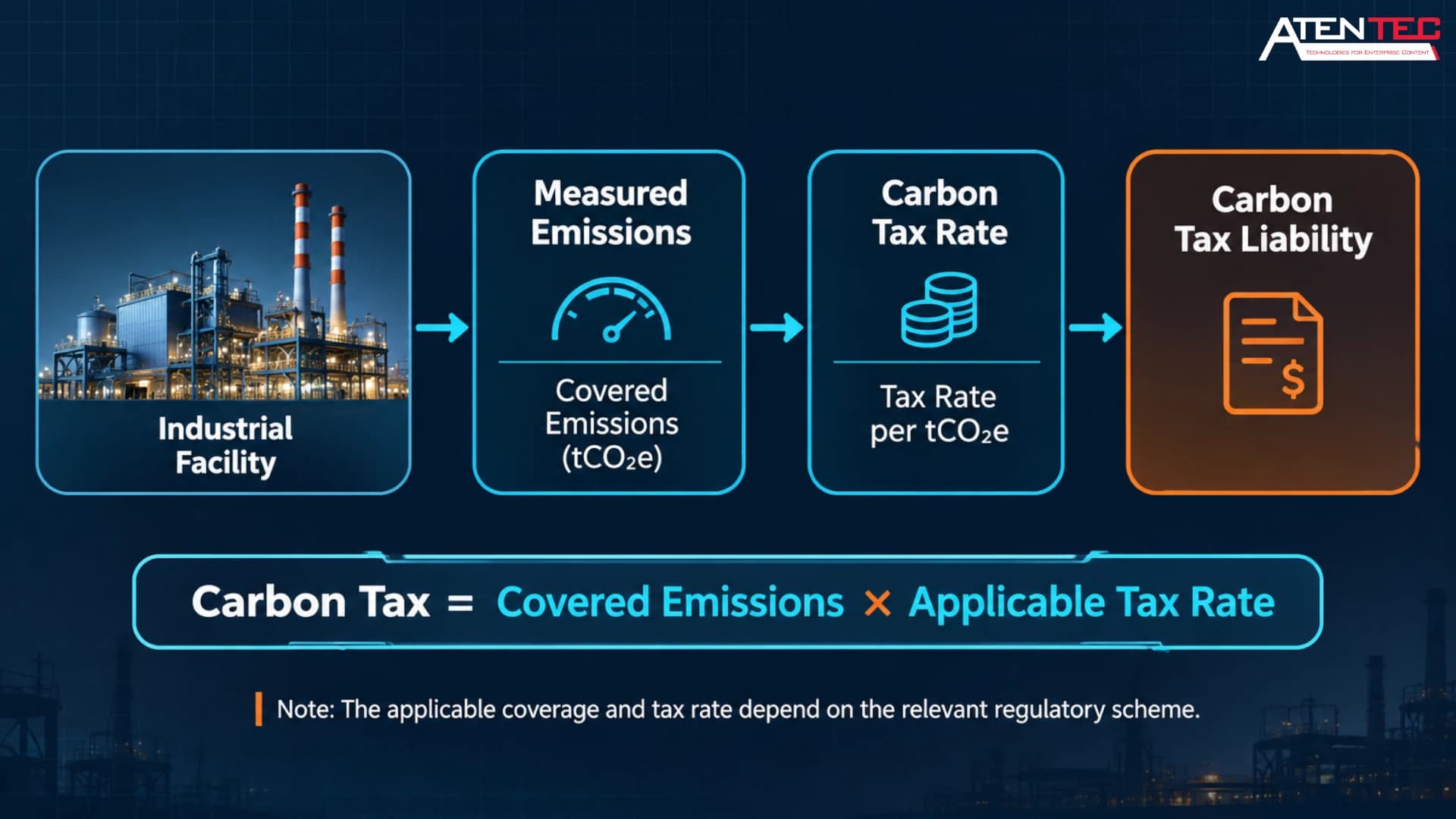
For an industrial operator, a carbon tax becomes financially meaningful only when three questions are answered correctly: which legal entity is liable, which emissions or fuels fall inside the tax base, and how the taxable quantity is measured. A corporate carbon footprint is not automatically the tax return. A plant may report Scope 1, Scope 2 and Scope 3 emissions for management purposes while the applicable tax covers only specified fuels, gases, installations or processes.
That distinction matters in manufacturing because emissions arise from different physical mechanisms. A cement kiln releases CO₂ when limestone is chemically converted into clinker, as well as when fuel is burned to provide heat. A blast furnace uses carbon not merely as a fuel but also as a reducing agent. An ammonia plant uses natural gas or coal both as feedstock and as an energy source. A tax system may treat these sources differently, and the applicable legislation—not a generic Scope 1 total—determines the taxable base.
A plant-level calculation: the number that matters
Consider a cement works producing 1 million tonnes of clinker per year. Suppose its verified direct emissions are 0.54 tCO₂ per tonne of clinker from process chemistry (limestone calcination) and 0.33 tCO₂ per tonne from kiln fuel. These are illustrative values in line with the literature: industry-average gross emissions of roughly 0.87 tCO₂ per tonne of clinker, of which about 0.54 is process emissions, and a measured fuel-derived figure of about 0.34 tCO₂ per tonne at a UK plant studied in the research cited below. Its annual direct emissions would be:
- Process emissions: 1,000,000 × 0.54 = 540,000 tCO₂
- Fuel emissions: 1,000,000 × 0.33 = 330,000 tCO₂
- Total direct emissions: 870,000 tCO₂
If—and only if—the jurisdiction taxes both sources at an illustrative rate of €50/tCO₂, the gross exposure before exemptions, free allocation, rebates or other statutory adjustments would be €43.5 million. This is an arithmetic illustration, not a statement about any country's tax rate or the actual liability of a named cement producer.
The calculation exposes a critical operational point: a 5% reduction in kiln-fuel emissions would save 16,500 tCO₂, worth €825,000 at the illustrative rate. It would not remove the 540,000 tonnes arising from limestone calcination, which is roughly 60% of the plant's direct emissions in this example. Fuel efficiency is therefore valuable, but it cannot by itself solve the cement plant's carbon-cost problem. The investment case may also need clinker substitution, alternative binders, carbon capture, or a change in product mix.
Evidence from manufacturing: carbon pricing can change firm behaviour
A 2024 peer-reviewed study, The Effect of Carbon Pricing on Firm Emissions: Evidence from the Swedish CO₂ Tax, assembled 26 years of emissions data from Swedish manufacturing firms. The authors estimated an elasticity of around two between the marginal cost of emitting and firm-level emission intensity (emissions per unit of sales): a 1% rise in the marginal cost of emitting was associated with roughly a 2% fall in emissions per unit of sales. In a simple calibration, they estimated that manufacturing CO₂ emissions in 2015 would have been roughly 30% higher without carbon pricing. The authors also found substantial variation between firms and subsectors: firms facing higher abatement costs or tighter financial constraints responded less strongly.
The important lesson is not that every factory will reduce emissions by 30%. It is that a price signal interacts with process flexibility, capital availability and the cost of abatement. A plant with waste-heat recovery opportunities may respond quickly; a process-emissions-intensive kiln may need a major technology change. Applying one company-wide reduction assumption to both plants would be poor financial modelling.
Source: Martinsson, Sajtos, Strömberg and Thomann, Review of Financial Studies (2024), The Effect of Carbon Pricing on Firm Emissions.
Cement: operational variation is a taxable opportunity
A peer-reviewed study of a single UK cement plant (a pre-calciner kiln commissioned in 1986) examined daily production data. Fuel-derived CO₂ per tonne of clinker varied by roughly 10–12% between the plant's average and its 90th-percentile performance, and energy use per tonne by about 6–7%. The analysis identified flue-gas flow (driven by excess air) and fuel type as the dominant drivers. Modelling the plant with several key drivers optimised at once suggested potential reductions of approximately 8.5% in energy use and 19.5% in fuel-derived CO₂—results close to the plant's best observed performance.
This is a much more useful finding for a plant manager than the generic instruction to “improve energy efficiency”. It points toward kiln-control variables that can be monitored: fuel composition and calorific value, oxygen concentration in kiln exhaust, exhaust-gas flow and temperature, clinker output and operating stability. If the emissions inventory is calculated only from monthly fuel invoices, it may reveal the annual total but conceal the operating conditions responsible for avoidable emissions.
The study should be read with its limits in mind. It is one plant, and the authors themselves state that a single case study is not yet robust enough to apply at an operational level. The 8.5% and 19.5% figures are model predictions, not measured savings. The calculation also counts all fuel-derived carbon without adjusting for biomass, so the saving under a tax or trading rule that treats biogenic fuels differently could be smaller. Its value is methodological: use measured operating data to identify the gap between current performance and the plant's own demonstrated best performance.
Source: Summerbell, Barlow and Cullen, Journal of Cleaner Production (2016), Potential reduction of carbon emissions by performance improvement: A cement industry case study.
Chemicals: feedstock accounting is not optional
Ammonia production illustrates why process boundaries matter. The International Energy Agency reports direct emissions of about 2.4 tCO₂ per tonne of ammonia globally (2021 basis), with large differences between production routes. Natural-gas steam methane reforming and coal gasification do not have the same emissions profile; the IEA also reports that the global average energy intensity is around 41 GJ/t ammonia on a net basis, compared with best-available-technology levels of 28 GJ/t for natural-gas-based production and 36 GJ/t for coal-based production.
For a plant producing 500,000 tonnes of ammonia annually, a direct-emissions intensity of 2.4 tCO₂/t implies 1.2 million tonnes of direct CO₂ per year. A reduction of 0.1 tCO₂/t would avoid 50,000 tonnes annually. At an illustrative carbon price of €50/t, that is €2.5 million of gross annual exposure avoided, before considering the plant's actual legal treatment, allowances, exemptions, energy-price effects or investment costs.
This is why the plant's carbon model must distinguish feedstock consumption, process fuel, purchased electricity, hydrogen production route and any captured or transferred CO₂. A single natural-gas consumption figure may not be enough to reconstruct the correct process emissions or to explain why two ammonia plants using different technologies have different intensities.
Source: IEA, Ammonia Technology Roadmap – Executive Summary.
Taxable emissions, carbon cost and the investment decision
A carbon-tax model should not stop at multiplying emissions by a headline rate. It should show at least four layers:
- Gross emissions: the measured or calculated emissions from each covered source.
- Legal adjustments: exemptions, thresholds, tax rates, rebates, sector-specific rules or interactions with an ETS, where the law provides them.
- Net liability: the amount the liable entity must report and pay.
- Economic pass-through: carbon costs embedded in electricity, fuels, raw materials or logistics, which may affect the factory even when another entity is the legal taxpayer.
For a multi-site manufacturer, the distinction between legal liability and economic exposure is essential. A plant may not file the tax return itself, yet still face a higher electricity or fuel bill because a supplier passes through carbon costs. Conversely, a facility may be directly liable for process emissions but receive statutory relief. These are different risks and should not be merged into one “carbon cost” line.
What a defensible carbon-tax data trail looks like
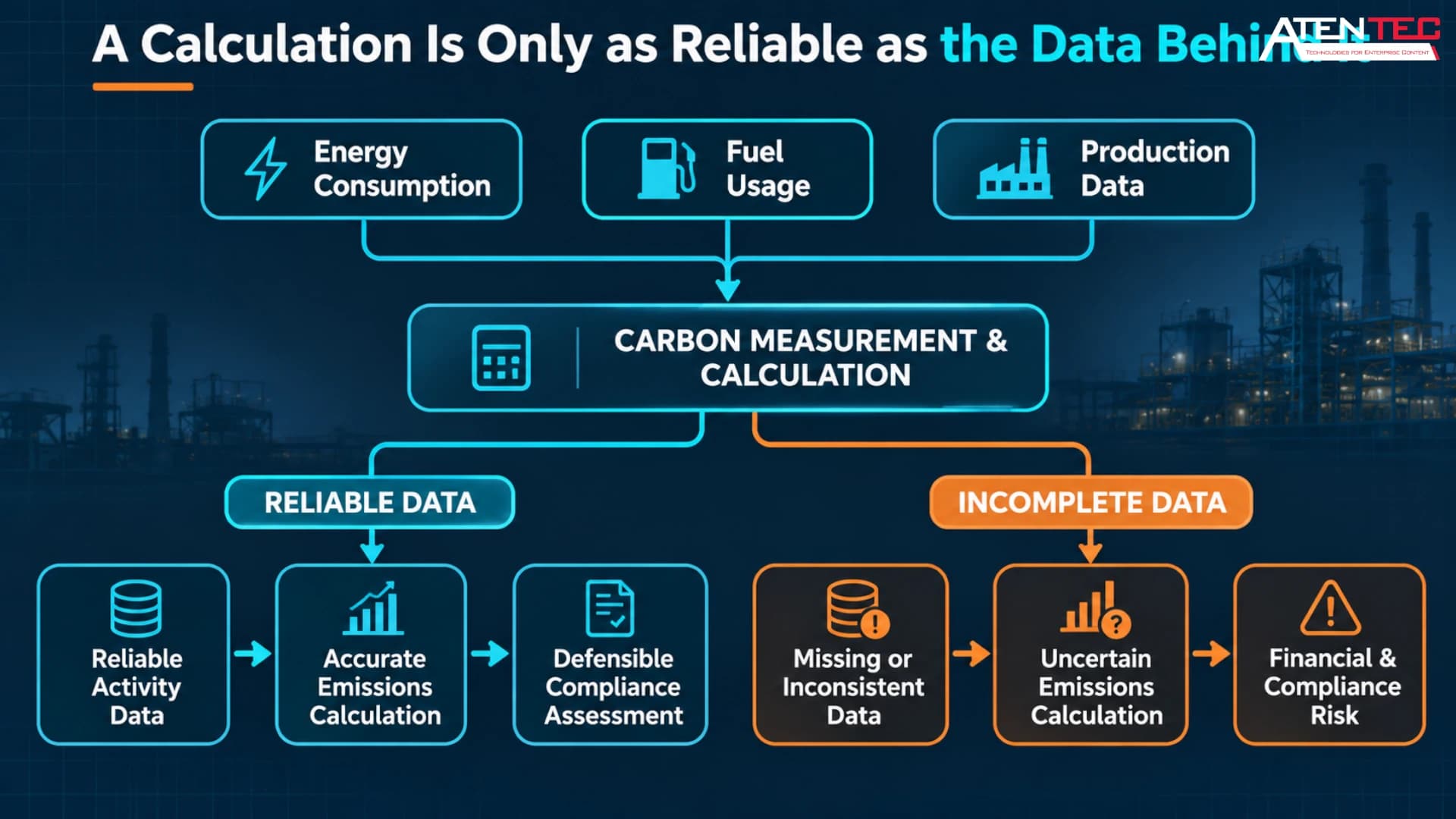
For each covered source, the company should be able to trace the reported amount back to operational evidence: fuel delivery and consumption records, calibrated meters, laboratory fuel analyses where relevant, production records, process measurements, emission-factor versions, calculation logic, and review approvals. Reconciliation matters. Fuel consumed by the kiln should reconcile with purchasing, stock movements and operating records. Emissions per tonne of clinker should be explainable when production drops or the fuel mix changes.
The company should also retain the distinction between measured data and estimates. An estimate may be permitted under a particular methodology, but it should not be presented as a direct measurement. The source, factor, assumption, uncertainty and reason for estimation should be documented.
From annual reporting to operating control
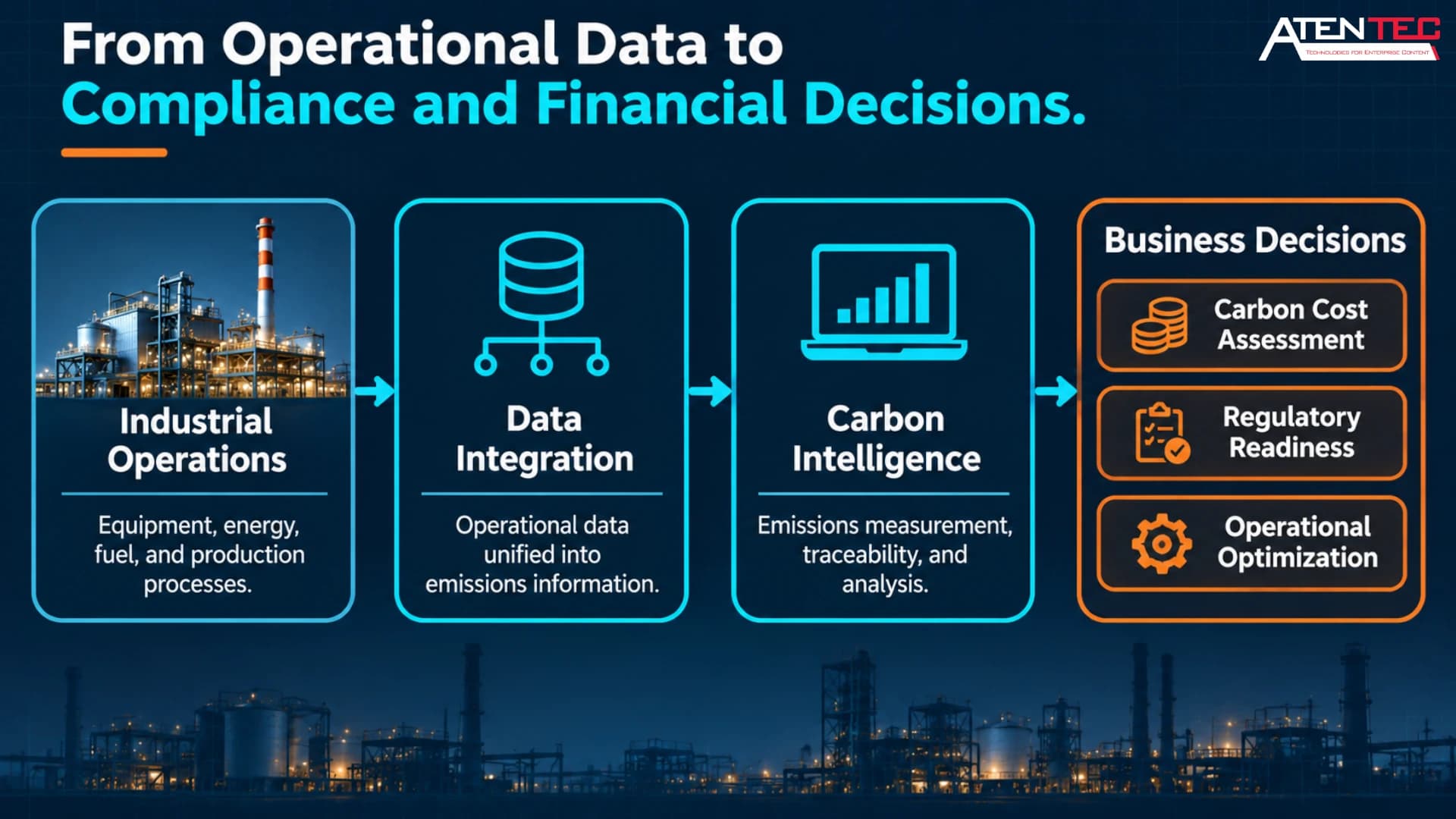
A plant that calculates carbon cost once a year is likely to discover its exposure after the operating decisions have already been made. A more useful system links production, fuel, process conditions and emissions at a frequency that supports intervention. It can then test scenarios such as changing kiln fuel mix, improving thermal efficiency, increasing scrap in steelmaking, switching ammonia feedstock, or altering production schedules.
AtenTEC's role is to support the industrial data foundation behind these decisions: connecting activity data, calculation methods and traceable emissions records, then using scenarios to assess how operational assumptions affect emissions and potential cost. It does not replace the applicable tax law, a tax adviser, a verifier or the company's statutory controls.
What This Means for Egyptian Manufacturers
Egypt does not currently apply a general carbon tax to industrial CO₂ emissions. Press reporting on the Ministry of Finance's position describes a per-litre fee on certain petroleum products but no explicit tax on carbon emissions, and a first carbon-pricing draft law has been reported as under preparation. The status of any such law changes, so confirm the current position with the Ministry of Finance and the Ministry of Environment before building it into a financial model.
That does not make the topic academic for an Egyptian plant, for three reasons.
- The EU already prices Egyptian exports' carbon through CBAM. Under CBAM, a carbon price effectively paid in the country of origin can be deducted from what the EU importer owes. The Commission has said it will set rules for that deduction and, from 2027, may publish default carbon prices for countries that operate a pricing instrument. Egyptian planning-institute analysis reported in July 2026 makes the same point: with no domestic carbon price, there is nothing to deduct; if one were introduced, importers would deduct it. Whether and how Egypt prices carbon is a policy choice, but the commercial logic of the choice depends on plant-level data. See our CBAM article in this series.
- A future domestic instrument is unlikely to be defined at corporate-footprint level. As this article shows, a tax base is usually defined by sources, fuels, gases and installations. A plant that holds source-by-source records today (kiln fuel, calcination, feedstock, purchased electricity) can answer any of those definitions later; a plant with only a corporate total cannot.
- Energy-price effects arrive without a tax. Egyptian heavy industry relies heavily on natural gas, so changes in gas pricing and supply affect cost structure in a way that is conceptually similar to a carbon price. Modelling emissions and energy together, by process, is the sensible baseline.
Practical starting point: build a source-level emissions record for each installation now (fuels, process chemistry, feedstock, electricity), with documented factors and ownership. The same record supports CBAM data requests from EU customers, any future national instrument, and the disclosure obligations covered in our ESG article.
Questions manufacturers should ask
Is a company's full carbon footprint always taxable? No. The taxable base depends on the jurisdiction's legislation and may cover only defined fuels, gases, sectors, installations or processes.
Can a plant reduce its carbon tax by improving energy efficiency? It may reduce the taxable emissions associated with covered energy use, but process emissions and legal adjustments must be assessed separately.
Why do two factories making the same product have different carbon-tax exposure? Their production routes, fuel mix, process efficiency, output, legal coverage and available relief may differ.
Can a carbon accounting platform determine the tax legally owed? Software can organize data and apply configured calculation logic, but legal applicability, tax interpretation and statutory sign-off remain the responsibility of the company and its qualified advisers.
Does Egypt have a carbon tax? Not on industrial CO₂ emissions as a general tax, based on the sources reviewed; a draft carbon-pricing law has been reported. Check the current status before relying on this.
Carbon tax is not an abstract sustainability charge. In manufacturing, it connects a legal rule to specific tonnes of fuel-related and process-related emissions. The strongest response is not simply to report a lower corporate footprint; it is to know which process creates each tonne, what the applicable law taxes, what can be reduced operationally, and which investments change the plant's long-term exposure.
At AtenTEC, we turn carbon emissions into an industrial data system that drives compliance, pricing and operational decisions.
Explore the Full Knowledge Architecture:
CARBON EMISSIONS DOMAIN
├── 1. Core Concepts 👉(Carbon Emissions Explained ✅) 👉
├── 2. Measurement Systems 👉 (Introduction to Measurement Systems)
├── 3. Regulation Layer 👉(From Sustainability to Compliance Pressure)
│ ├── carbon tax 👉 (You are here)
│ ├── ETS / cap and trade 👉 (Next Article)
│ ├── CBAM compliance 👉 (Upcoming)
│ └── ESG regulations 👉 (Upcoming)
├── 4. Supply Chain Layer 👉 (Upcoming)
In this series, we will examine how these measurement systems interact directly with legal and financial enforcement mechanisms—beginning with the strategic mechanics of Carbon Tax Architecture and CBAM Compliance.
As we promised from the beginning of this journey, we are unpacking each layer of the carbon domain not as static definitions, but as actionable operational frameworks.
Is your current MRV system providing genuine audit certainty, or is it masking structural data gaps?
*Regulatory note (information current to November 2026): Carbon-tax coverage, rates, liable entities, exemptions, reporting rules and interactions with emissions trading vary by jurisdiction and can change. Statements about Egypt reflect public reporting and official announcements. The numerical plant examples above are illustrative and must not be treated as a tax assessment.