MRV Systems: Why Emission Verification Fails in Real-World Industrial Data
In corporate boardrooms and sustainability disclosures, Monitoring, Reporting, and Verification (MRV) is routinely referenced as the gold standard for climate accountability. The concept carries an appealing linear simplicity: monitor operational activities, report the resulting greenhouse gas emissions, and invite an independent third party to verify the final metrics. Under standard conditions, this triad is assumed to create total transparency, providing regulators, financial markets, and supply chain partners with trustworthy data.
However, when this theoretical framework collides with the messy physical reality of heavy industry—such as steel production, chemical manufacturing, and complex logistics networks—the traditional MRV model breaks down.
In practice, third-party verifiers are rarely auditing physical thermodynamic events; instead, they are auditing retrospective spreadsheets, historical estimates, and unaligned data streams. This creates a dangerous structural vulnerability. As carbon pricing mechanisms like the European Union’s Carbon Border Adjustment Mechanism (CBAM) and regional Emissions Trading Systems (ETS) transition from voluntary disclosures to enforceable financial liabilities, relying on static, annual MRV audits exposes companies to severe compliance penalties, tariff adjustments, and reputational collapse.
At AtenTEC, our guiding paradigm is uncompromising: "We turn carbon emissions into an industrial data system that drives compliance, pricing, and operational decisions."
To fulfill that promise, MRV cannot remain a passive post-operational exercise. It must be reconstructed as a deterministic, digital infrastructure embedded directly within the industrial plant floor.
1. Deconstructing the Triad: Monitoring, Reporting, and Verification
To understand where verification fails, we must first break down the three distinct components of the MRV system and examine the failure modes inherent to traditional implementations.
Monitoring: The Telemetry Ingestion Barrier
Monitoring represents the physical interface between operational machinery and data systems. In heavy manufacturing, this involves tracking fuel flow rates, flue gas concentrations, electricity drawn from smart meters, and raw material inputs across diverse Operational Technology (OT) networks.
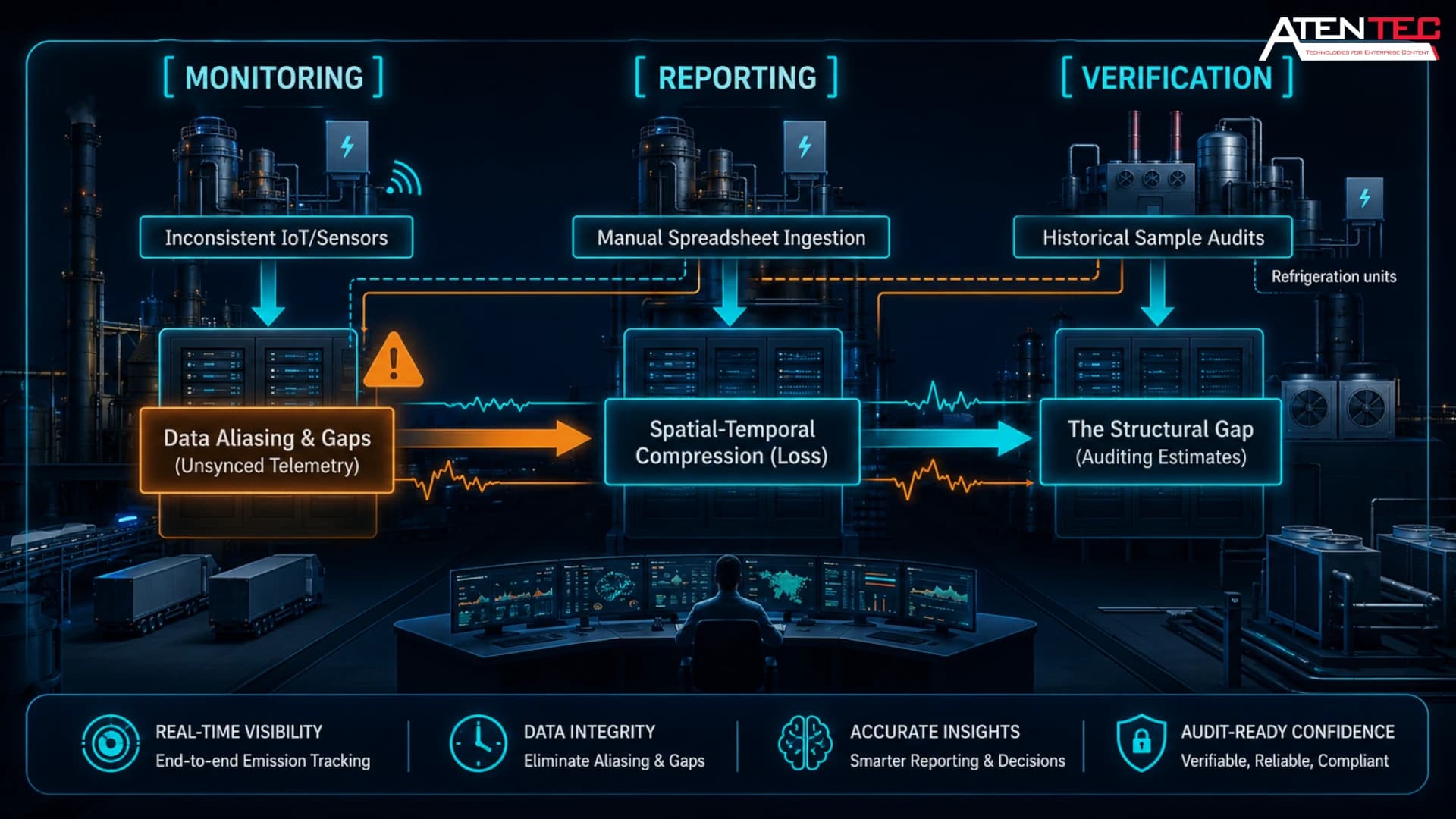
- The Flaw: Industrial plants rarely operate on uniform IT architectures. Telemetry is trapped in legacy Data Silos—ranging from analog sensors, Modbus networks, and OPC-UA protocol drivers to localized SCADA interfaces. When data ingestion lacks temporal synchronization, sensor drift and missing packets distort the baseline.
Reporting: The Loss of Granularity
Reporting is the translation layer where raw physical data is formatted into structured inventory reports according to global protocols (such as the GHG Protocol or ISO 14064).
- The Flaw: Traditional reporting flattens high-frequency physical phenomena into static monthly or annual averages. In doing so, it destroys critical spatial and temporal context. A sudden combustion inefficiency or short-lived fugitive gas leak is erased, compressed into an generalized bulk figure.
Verification: The Retrospective Audit Trap
Verification is the legal and technical assurance process conducted by accredited third-party bodies to confirm that reported numbers present a fair and accurate account of emissions.
- The Flaw: Third-party auditors typically conduct sample-based testing months after the operational events have occurred. They inspect static documents, fuel purchase receipts, and mathematical formulas in spreadsheets. If the underlying monitoring data was built on generalized assumptions or unverified estimates, the verifier is merely confirming that the math behind an inaccurate assumption was executed correctly.
Key Takeaway: Traditional MRV does not verify physical emissions; it verifies mathematical consistency within human-assembled spreadsheets.
2. Real-World Case Studies: Where Traditional MRV Collapses
To illustrate how these structural gaps manifest in practice, let us examine two real-world industrial scenarios.
Scenario A: The Integrated Steel Works (Data Aliasing Error)
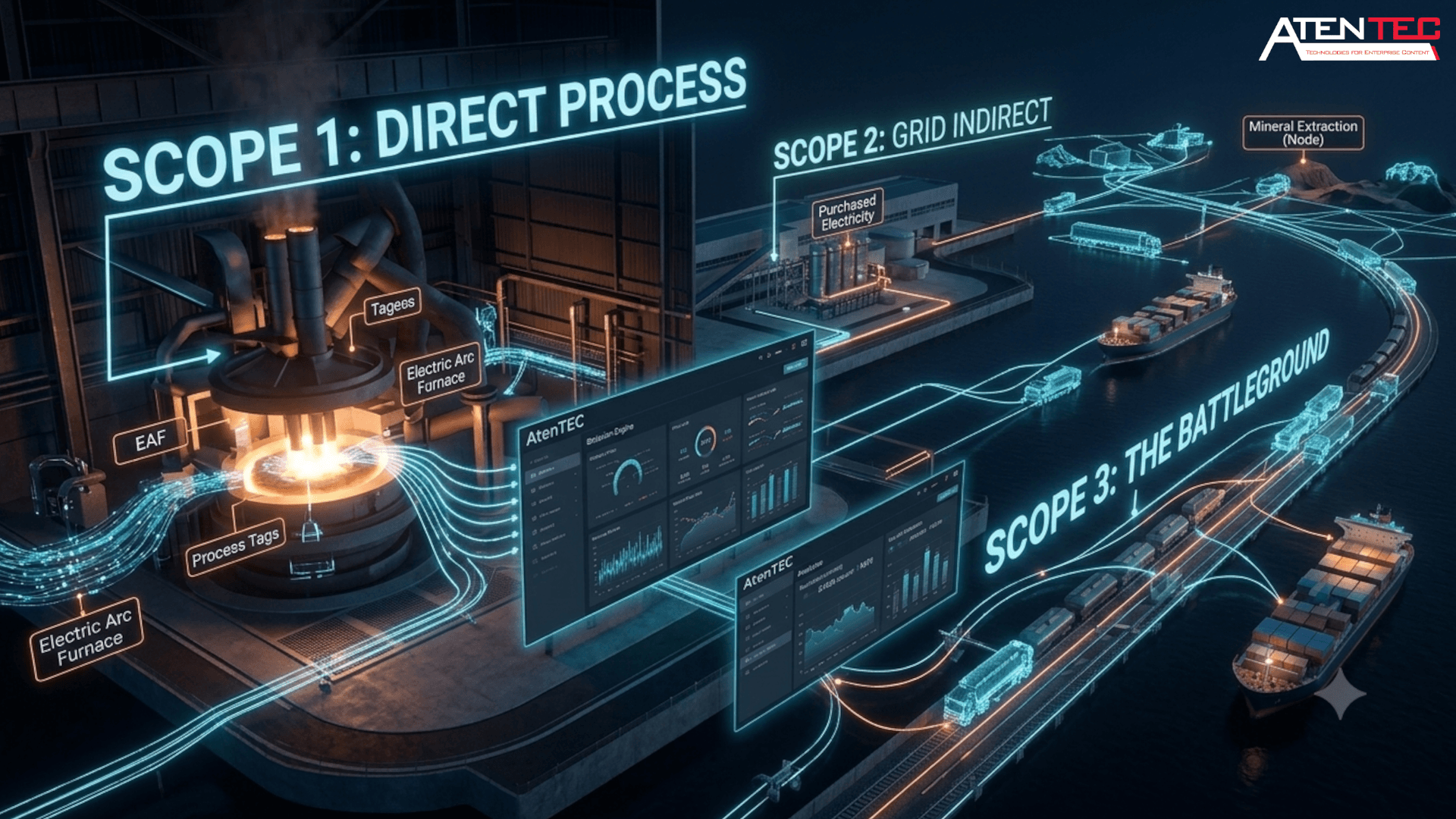
Consider a continuous steel manufacturing facility operating blast furnaces, electric arc furnaces, and rolling mills. The facility tracks direct Scope 1 combustion emissions via fuel meters while utilizing regional grid emission factors for Scope 2 power draw.
- The Incident: During a peak production quarter, the plant experiences frequent power fluctuations, forcing auxiliary gas-fired peaker units to cycle on and off rapidly to maintain thermal balance.
- The Traditional MRV Failure: The plant's monitoring system relies on daily manual meter reads and monthly utility invoices. The high-frequency operational spikes—where carbon intensity surged by 40% for multi-hour intervals—are completely smoothed out in the monthly aggregation.
- The Consequence: During an international CBAM compliance review, European importers cross-examine the plant's embedded carbon calculations against regional energy grid logs. The temporal discrepancy reveals a structural Data Aliasing Error. The verifiers reject the reported emissions profile, subjecting the steel exporter to punitive carbon tax adjustments at the border.
Scenario B: Chemical Manufacturing (Fugitive N₂O & Methane Discrepancy)
Scenario B: Chemical Manufacturing, Fugitive Nitrous Oxide (N₂O) Discrepancy A chemical plant producing nitric acid and specialized polymers implements an annual MRV framework to disclose its Scope 1 greenhouse gas emissions.
The Incident: A high-pressure valve on a secondary reactor develops a micro-fissure, causing a continuous, low-volume release of nitrous oxide (N₂O), a potent greenhouse gas with a Global Warming Potential (GWP) of nearly 273 times that of carbon dioxide (CO₂) under the relevant GWP framework.
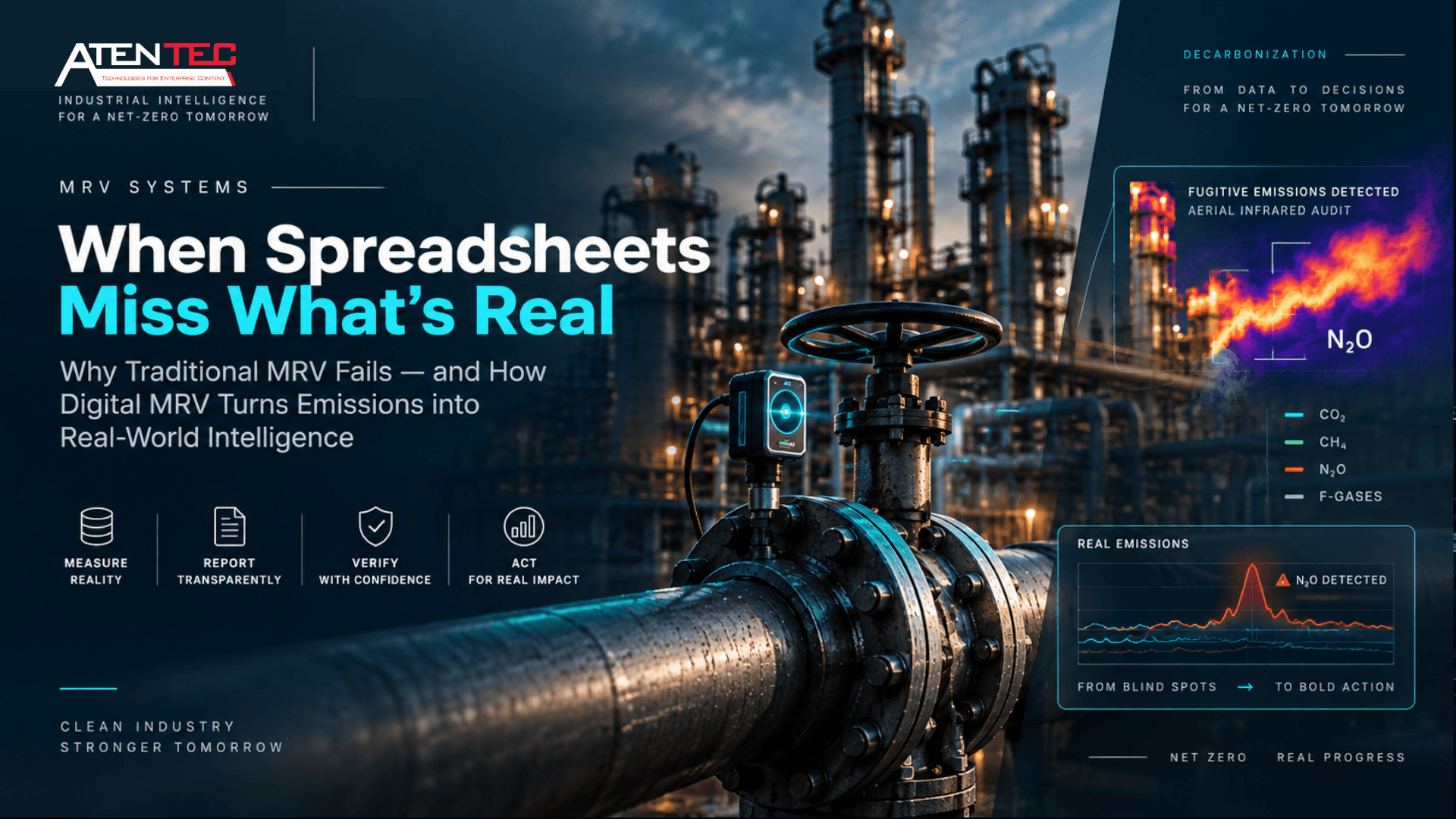
The Traditional MRV Failure: The plant’s annual MRV framework calculates N₂O emissions primarily from theoretical stoichiometric production yields rather than continuous, direct monitoring of the physical process. Because the calculation is based on expected production relationships rather than real-time measurement of actual gas releases, the continuous fugitive nitrous oxide leak remains invisible in the annual emissions inventory. This illustrates a fundamental weakness in traditional MRV: a mathematically consistent emissions calculation can still fail to represent what is physically occurring inside the plant. The reporting system may reconcile production volumes and emission factors correctly while completely missing an abnormal release occurring at a specific valve or process node. This is precisely the type of granularity loss highlighted in the MRV article, where short-lived or localized fugitive emissions can disappear when complex physical events are compressed into monthly or annual reporting figures.
The Consequence: A subsequent high-resolution aerial infrared audit conducted by environmental regulators identifies the fugitive N₂O plume. The plant is then exposed to major regulatory fines, forced to retroactively restate three years of carbon balance sheets, and loses its Tier-1 supplier certification with international off-takers. The case demonstrates why traditional MRV can verify the mathematical consistency of reported emissions without necessarily verifying the physical emissions themselves. When monitoring is periodic and reporting is based on generalized assumptions, a localized release of a high-impact greenhouse gas can remain undetected until an external physical measurement reveals the discrepancy.
3. The Digital MRV Revolution: Deterministic Infrastructure
Overcoming the failures of legacy verification requires transitioning from Manual, Periodic MRV to Digital, Continuous MRV (dMRV).
Digital MRV replaces manual data gathering and retrospective auditing with an automated, event-driven architecture that captures physical phenomena in real time, guaranteeing an uninterrupted, immutable audit trail.
The Architectural Pillars of Digital MRV
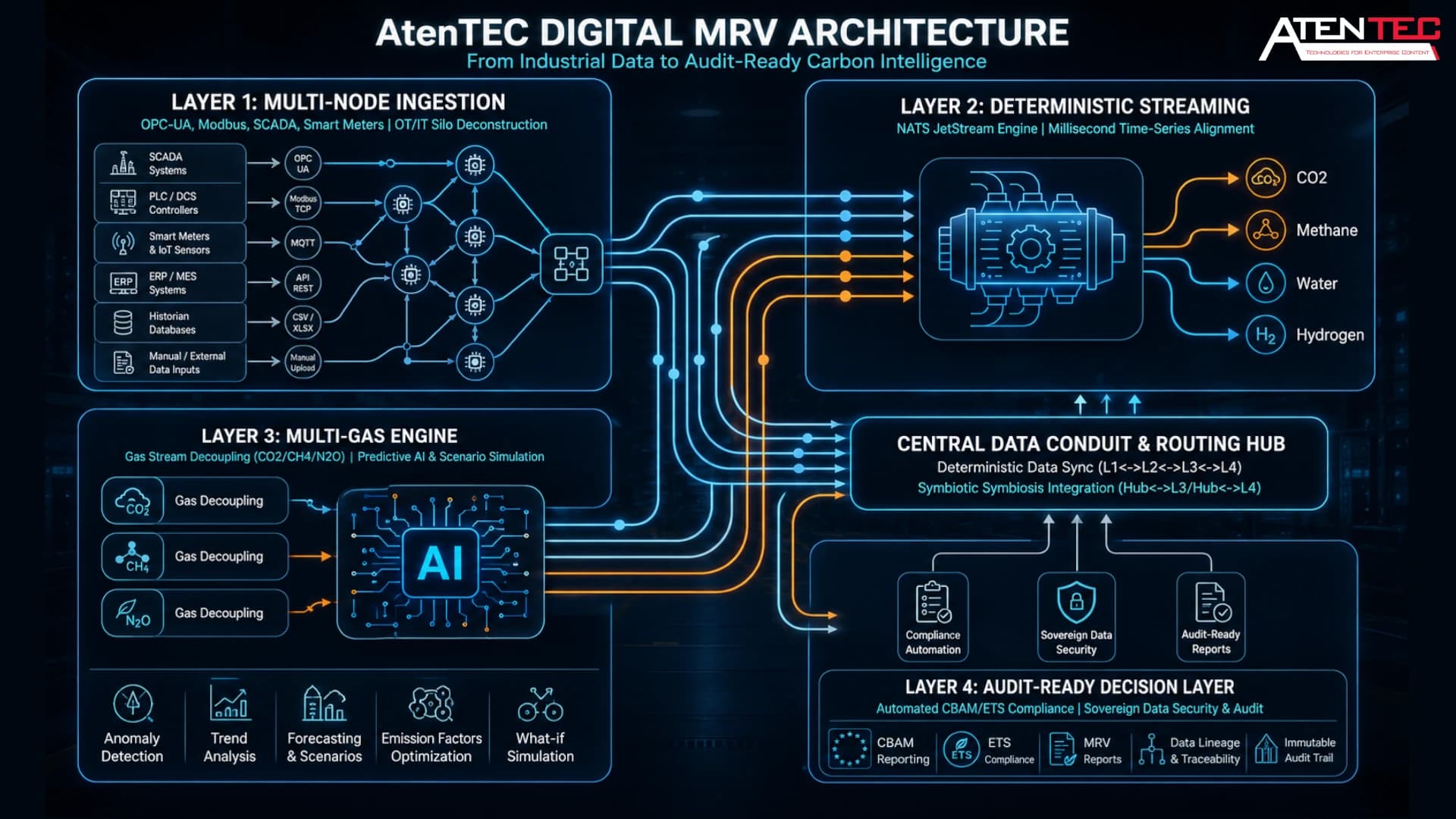
- Automated Ingestion Layer: Direct API and industrial protocol drivers connect directly to edge devices, gas analyzers, and power networks, eliminating human spreadsheet manipulation.
- Deterministic Time-Series Alignment: High-frequency data streams are aligned to exact milliseconds, matching real-time operational loads with dynamic grid emission factors.
- Cryptographic Integrity & Audit Trails: Every physical telemetry point is cryptographically hashed at the moment of ingestion, creating an immutable ledger that prevents retroactive data tampering.
- Multi-Gas Separation: Rather than prematurely collapsing activity into an abstract CO₂e figure, dMRV tracks carbon dioxide (CO₂), methane (CH₄), nitrous oxide (N₂O), and fluorinated gases (F-gases) independently to detect process-specific anomalies instantly.
4. How the AtenTEC Emission Engine Drives Sovereign Digital MRV
At AtenTEC, acting as the Technical Architect and Digital Orchestrator for complex industrial initiatives like the I-DNTITI project (Interactive Digital-hub for Net-zero Transition and Inclusion towards Transformative Industry), we transform scientific research and plant physics into real-world computing platforms.
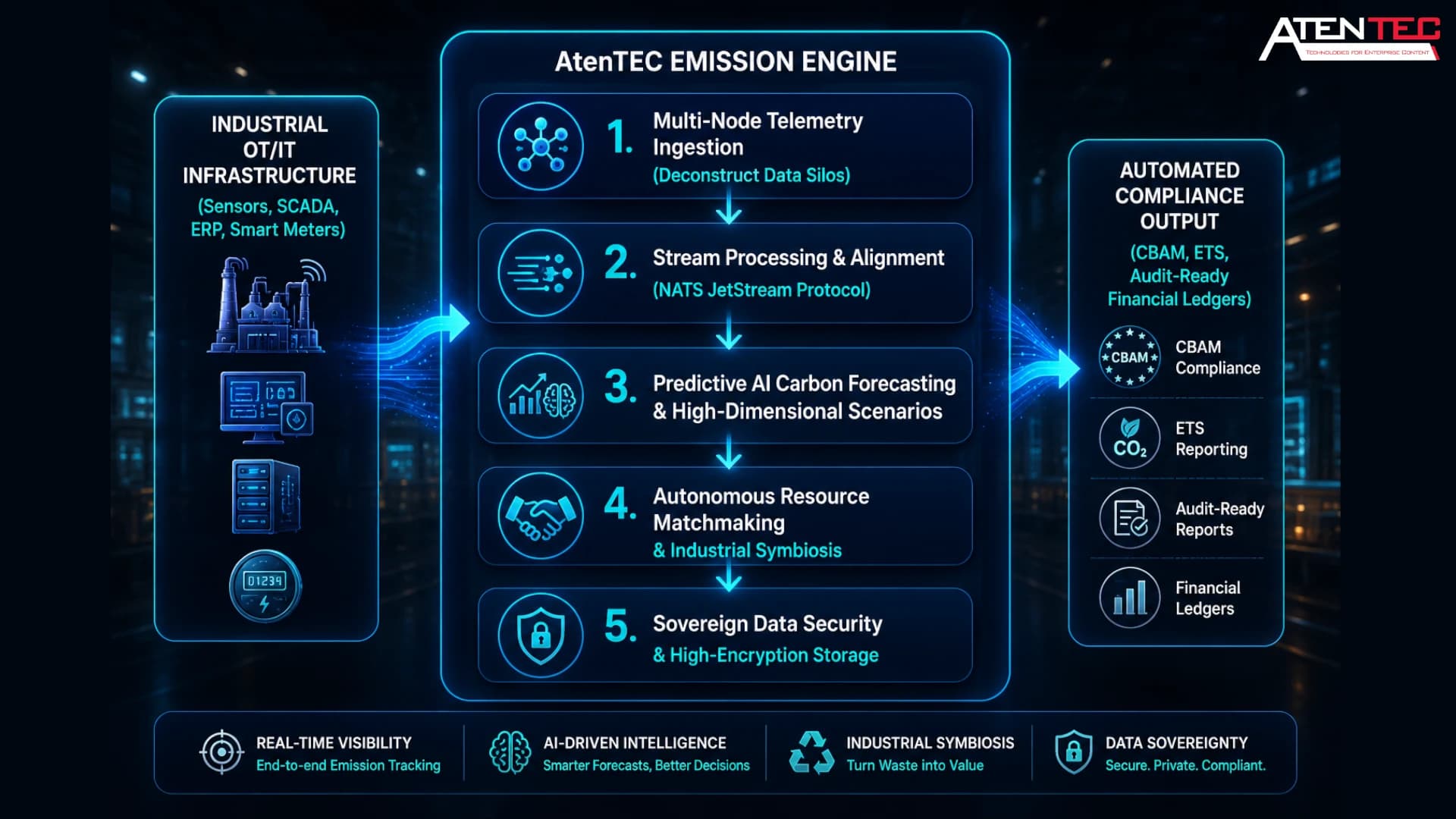
The AtenTEC Emission Engine powers digital MRV across heavy industrial facilities through five core capabilities:
1. Multi-Node Telemetry Ingestion
Heavy industrial plants operate on fragmented systems. The AtenTEC Emission Engine deconstructs these data silos by establishing high-throughput pipelines that pull live data directly from SCADA systems, smart meters, Modbus loops, and enterprise ERP systems (such as SAP or ATUM ERP). This links operational output with energy consumption in real time.
2. Deterministic Streaming via NATS JetStream
Processing thousands of industrial readings per second requires extreme system resilience. Our engine leverages an enterprise-grade stream processing layer built on NATS JetStream. This guarantees zero data loss during network disruptions and enforces precise time-series alignment, eliminating data aliasing errors across all nodes.
3. Predictive AI Carbon Forecasting
Beyond recording historical events, our engine incorporates advanced machine learning models to forecast future emissions profiles based on production schedules. Facility managers can execute dynamic Scenario Simulations—such as evaluating the exact financial and emissions impact of switching fuel sources or altering shift timing—before operational decisions are executed.
4. Autonomous Resource Matchmaking & Industrial Symbiosis
The software actively scans industrial networks for uncaptured energy and material waste (e.g., waste heat recovery, flare gas venting). Its autonomous algorithms calculate optimal re-routing options, enabling industrial symbiosis where waste outputs from one process line become useful inputs for adjacent industrial facilities.
5. Sovereign Data Security & Automated Audit Trails
Recognizing that industrial operational data touches sovereign economic interests and confidential trade practices, AtenTEC designs digital MRV architectures with sovereign-grade encryption standards. The platform translates complex engineering metrics into continuous, tamper-proof audit trails. This gives industrial exporters complete compliance readiness for stringent European and global regulators without exposing trade secrets.
5. Strategic Comparison: Legacy MRV vs. AtenTEC Digital MRV Architecture
To summarize the operational transition, consider the key technical differences:
| Architectural Metric | Legacy Analog MRV | AtenTEC Digital MRV Platform |
|---|---|---|
| Data Ingestion | Manual, invoice-based, spreadsheet-driven | Automated real-time telemetry (IoT, Modbus, OPC-UA) |
| Temporal Granularity | Monthly, quarterly, or annual averages | High-frequency time-series (millisecond alignment) |
| Verification Logic | Retrospective sample checks on static files | Continuous, cryptographic audit-ready event logging |
| System Visibility | Fragmented data silos, delayed reporting | Centralized, real-time industrial data orchestration |
| Decision Integration | Reactive post-event reporting | Proactive scenario modeling & AI predictive optimization |
| Regulatory Standing | Vulnerable to CBAM/ETS tariff adjustments | Instant compliance verification and audit readiness |
Reframing Verification: From Barrier to Competitive Advantage
When MRV is treated as a manual compliance chore, it represents an administrative burden and an unmanaged financial liability. But when reconstructed as a digital data architecture, it becomes a powerful driver of operational efficiency and market leadership.
Organizations that implement real-time, deterministic verification frameworks do not merely pass international climate audits—they gain granular control over their energy costs, optimize resource allocation, and protect their margins against global carbon tariffs.
By bridging the gap between plant floor physics and financial systems, digital MRV transforms carbon data from an abstract metric into an active decision variable.
Where This Leads Next in Our Knowledge Series
This article marks a critical juncture in Measurement Systems. Having deconstructed the core mechanics and verification challenges of MRV systems, we now turn our attention to the complete measurement architecture.
Here is how our connected series unfolds:
Explore the Full Knowledge Architecture:
CARBON EMISSIONS DOMAIN
├── 1. Core Concepts 👉(Completed ✅) 👉
├── 2. Measurement Systems 👉 (Introduction to Measurement Systems)
│ ├── Scope 1 / 2 / 3 👉 (Demystifying the Scopes)
│ ├── emission factors 👉 (The Fallacy of Static Emission Factors)
│ ├── lifecycle assessment (LCA) 👉 (The Static LCA Trap)
└── MRV systems 👉 (You are here)
├── 3. Regulation Layer 👉 (Next Article)
In our upcoming Regulation Layer series, we will examine how these measurement systems interact directly with legal and financial enforcement mechanisms—beginning with the strategic mechanics of Carbon Tax Architecture and CBAM Compliance.
As we promised from the beginning of this journey, we are unpacking each layer of the carbon domain not as static definitions, but as actionable operational frameworks.
Is your current MRV system providing genuine audit certainty, or is it masking structural data gaps?
Discover how the I-DNTITI Program and AtenTEC Emission Engine convert complex industrial telemetry into sovereign pricing intelligence and audit-ready compliance.
"We turn carbon emissions into an industrial data system that drives compliance, pricing, and operational decisions."