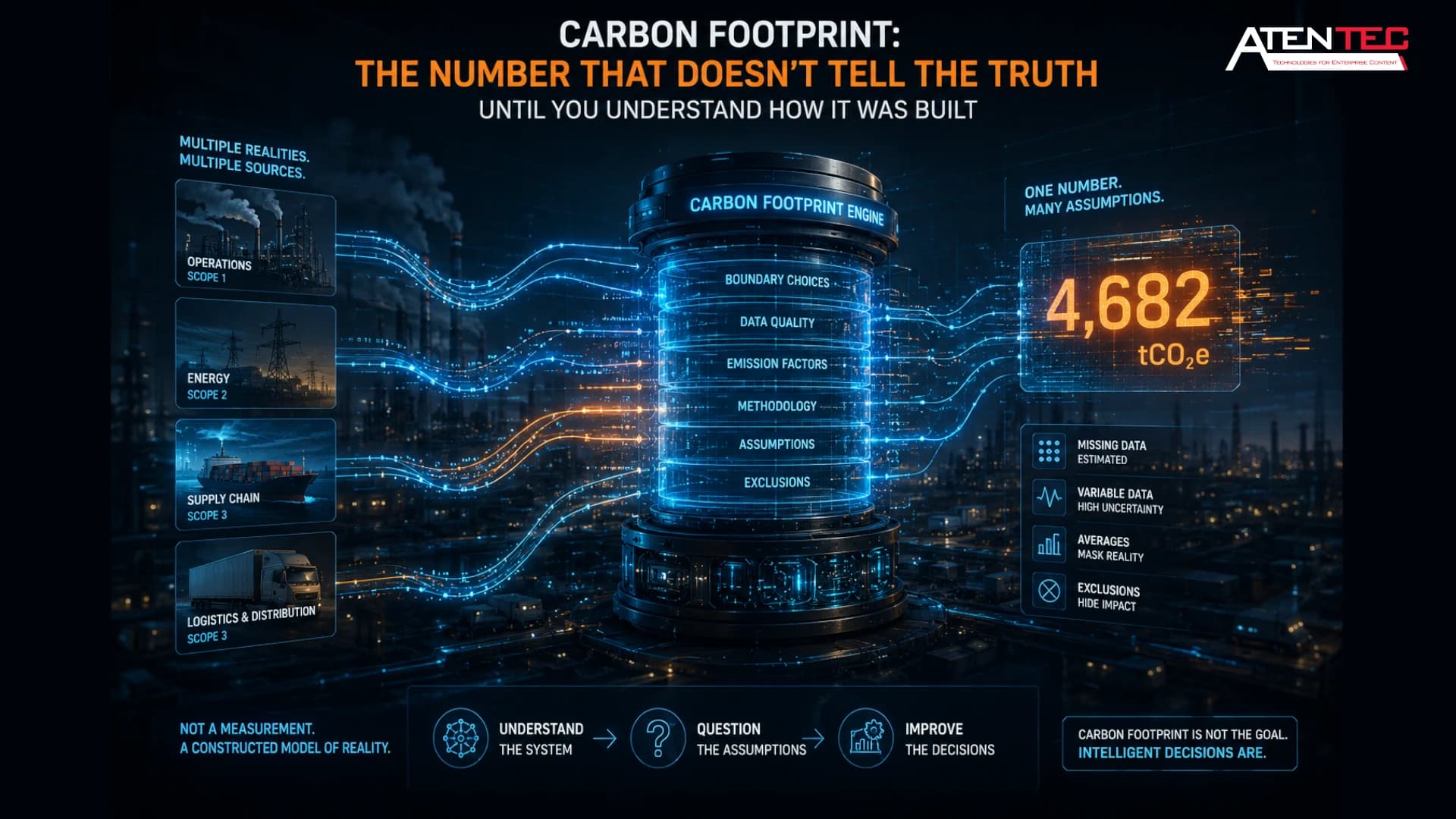
Carbon Footprint: The Number That Doesn’t Tell the Truth — Until You Understand How It Was Built
Carbon Footprint Is Not a Number — It’s a System You Either Control… or Misread.
What is Carbon Footprint and what does it really measure?
Most organizations talk about carbon footprint as if it is a fact.
A number that exists out there in the world. Stable, measurable, comparable.
But that assumption is exactly where the problem begins.
Because a carbon footprint is not something you measure directly. It is something you construct through layers of choices—choices about boundaries, data quality, emission factors, and what you decide to ignore.
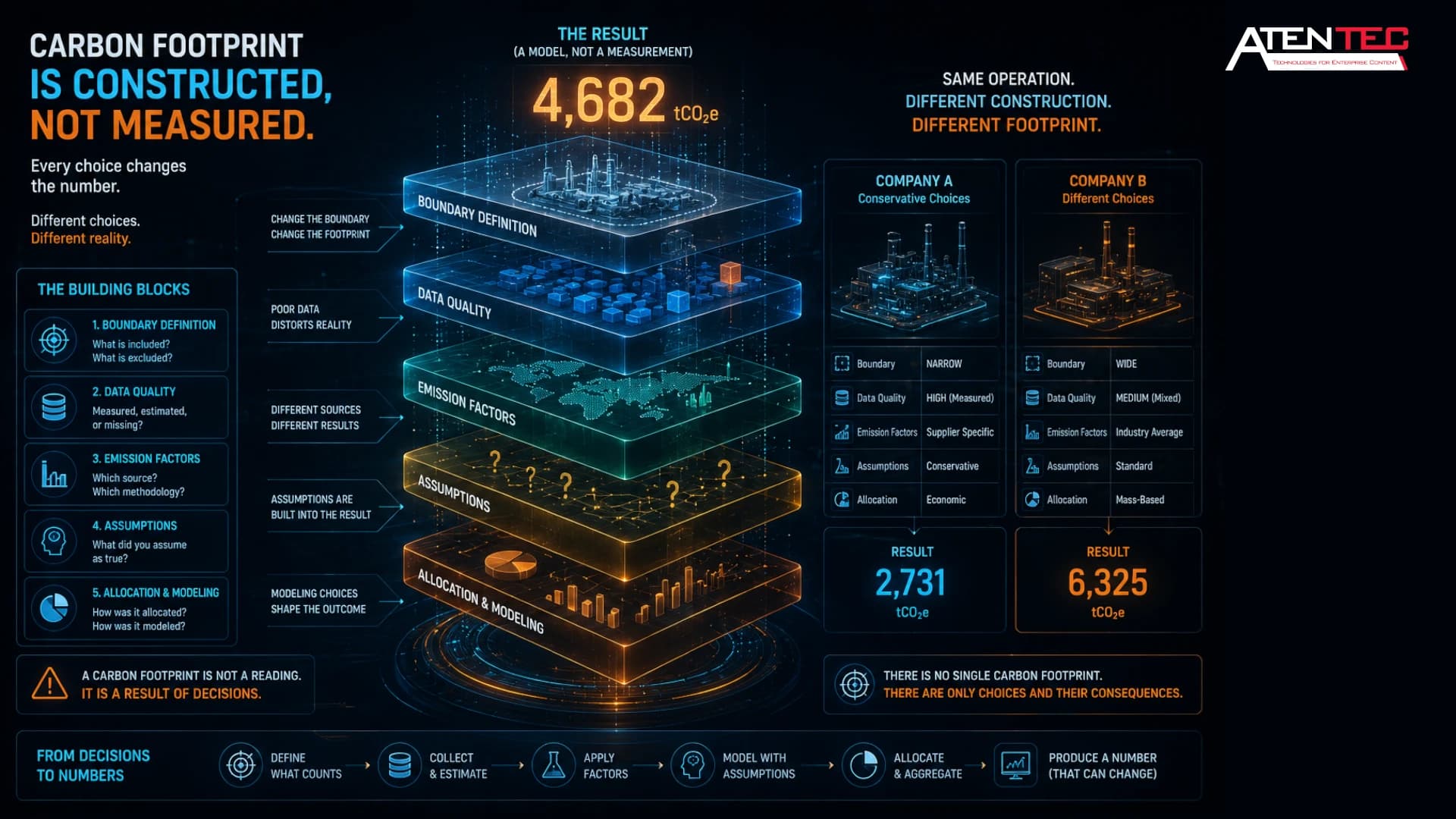
And the uncomfortable reality is this: two companies can report the same type of operation and end up with completely different carbon footprints, without either of them being technically wrong.
So the question is not “what is your carbon footprint?”
The real question is: what version of reality did you use to build it?
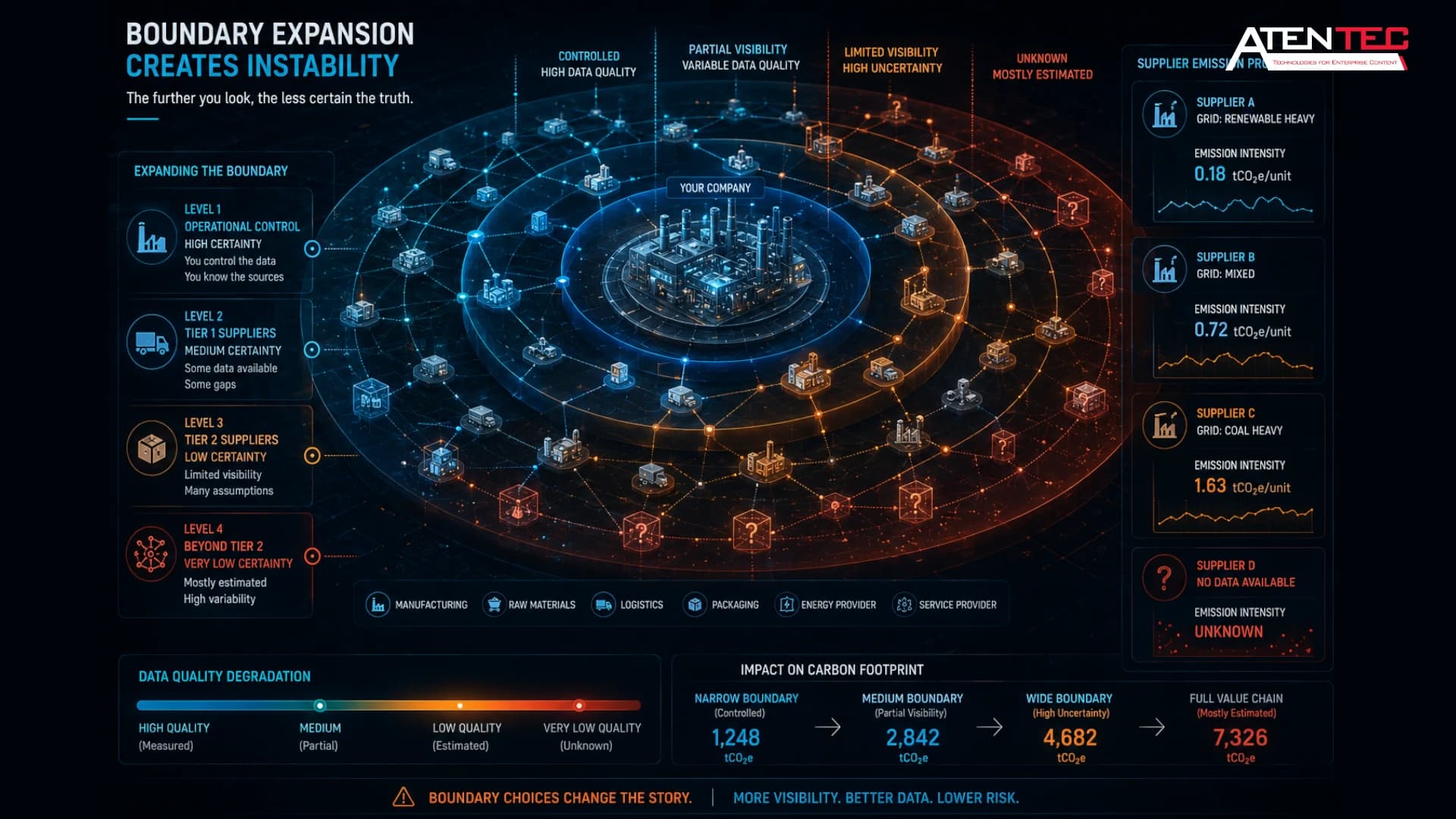
The moment you expand the boundary, the truth changes
Take a simple example: a manufacturing company producing metal components.
Inside the factory, everything looks straightforward. Energy consumption is tracked. Fuel usage is recorded. Direct emissions are calculated with relative confidence.
But once you start expanding the boundary, things become unstable very quickly.
The steel used in production comes from multiple suppliers. Each supplier operates under a different energy mix. Some rely on coal-heavy grids. Others use partially renewable systems. And some provide no emissions data at all, forcing the company to rely on generic emission factors.
At this point, the carbon footprint is no longer a measurement. It becomes a reconstruction.
Now consider what happens when a second company in the same industry uses a different approach. Instead of average emission factors, it integrates supplier-specific data for part of its supply chain.
The result is not just a different number. It is a completely different interpretation of the same physical reality.
This is where carbon accounting stops being accounting in the traditional sense. It becomes a system of estimation under uncertainty.
And this uncertainty is not a side issue. It is the core of the system itself.
GHG emissions are not the same thing as carbon footprint — and that distinction matters more than people think
One of the most common misunderstandings in this space is reducing everything to CO₂.
But carbon footprint is actually an aggregation of multiple GHG emissions, not a single gas.
Methane behaves differently. Nitrous oxide behaves differently. Even CO₂ behaves differently depending on where and how it is released.
Yet in practice, everything is converted into CO₂ equivalent using global warming potential factors.
This conversion is necessary for comparability—but it also introduces a distortion.
For example, a logistics company might reduce its visible CO₂ emissions by optimizing fuel usage, while methane leaks in upstream fuel production remain completely unaccounted for in operational decision-making.
The footprint improves on paper, while the real climate impact does not change proportionally.
So what you are seeing is not the full emission system. You are seeing a compressed representation of it.
The deeper issue is not calculation — it is carbon accounting logic itself
Carbon accounting is often treated as a technical process: collect data, apply emission factors, produce a result.
But in reality, it is a modeling system built on assumptions that most organizations do not fully control.
Emission factors, for example, are not fixed values. They vary depending on geography, methodology, and even the data source used.
A kilowatt-hour of electricity in one region can carry three times the emissions of another region. But many reporting systems still rely on annual averages that flatten this variability.
Now imagine applying that to a global supply chain.
A product assembled from ten different countries carries ten different emission realities. But in most carbon footprints, this complexity is compressed into a single average value.
At that moment, carbon accounting stops describing reality and starts simplifying it beyond recognition.
Carbon intensity is where the story becomes operational
Total emissions alone are not enough to understand performance.
Two factories can emit the same amount of CO₂, but one may produce twice the output. From a carbon intensity perspective, they are not equal at all.
This is where carbon intensity becomes critical—not as a reporting metric, but as a decision lens.
For example, in logistics operations, a company might increase total emissions simply because its delivery volume grows. But if route optimization reduces emissions per delivery, its carbon intensity improves.
So while the footprint grows, efficiency actually improves.
This is where traditional sustainability reporting starts to fail, because it cannot capture the difference between growth and inefficiency.
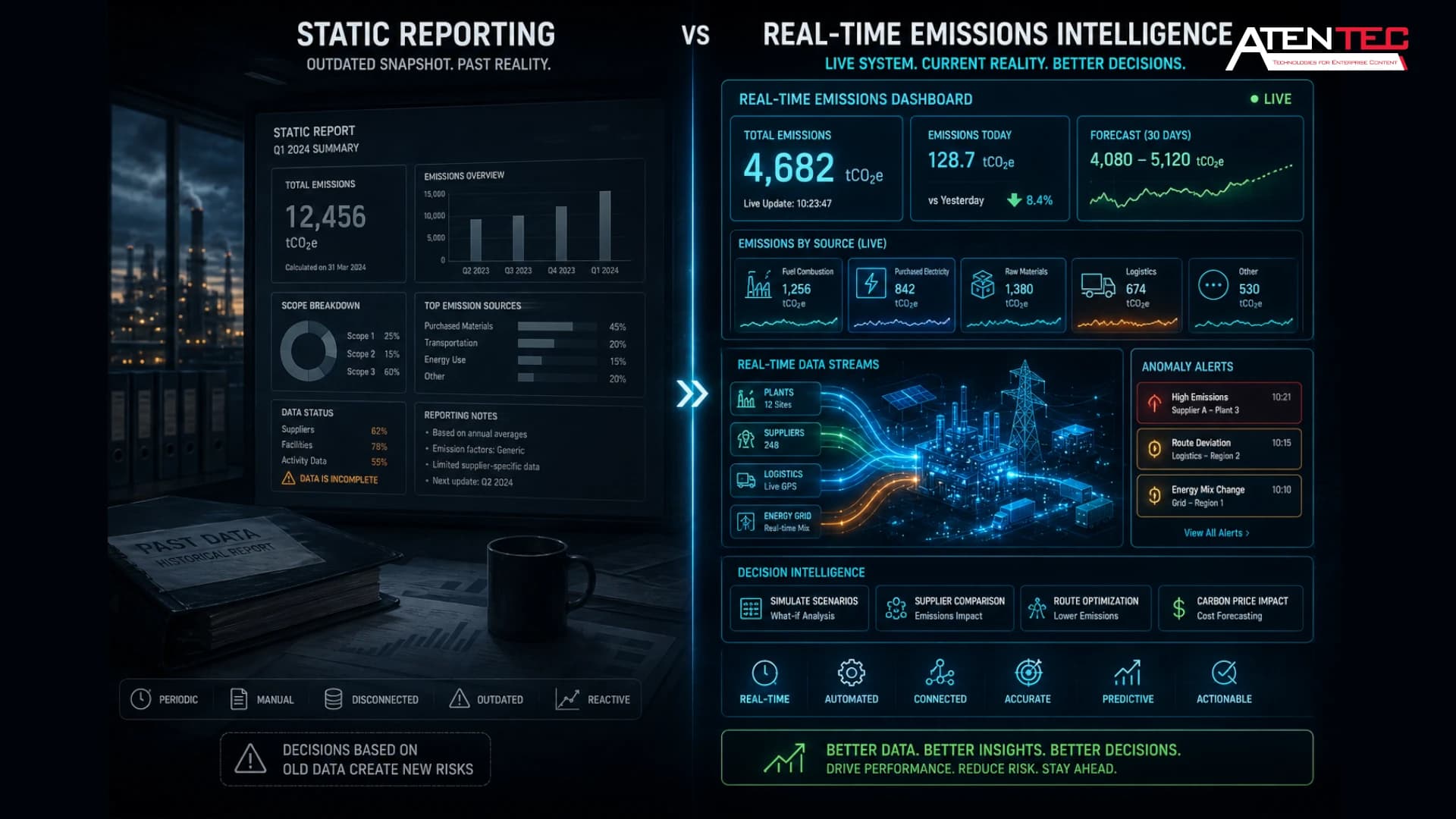
Why static carbon footprints fail under real operational pressure
Most organizations still calculate carbon footprints on periodic cycles—monthly, quarterly, or annually.
But operations do not behave in cycles. They behave in real time.
Fuel prices change. Routes change. Suppliers change. Energy sources change.
And every one of these changes alters the emissions profile immediately.
A static carbon footprint cannot reflect this dynamic behavior. It becomes a historical snapshot of a system that no longer exists.
This is why companies that rely only on static reporting often make decisions based on outdated emissions structures.
They are not optimizing their current system. They are optimizing a past version of it.
When carbon footprint becomes a decision system instead of a report
The real transformation happens when carbon footprint stops being an output and starts becoming an input into decision-making.
At that point, it is no longer just about reporting emissions.
It becomes about simulating them.
For example, a company considering a supplier switch is no longer just comparing cost and quality. It is evaluating how that change will reshape its emissions profile across Scope 1, Scope 2, and Scope 3 simultaneously.
Or a logistics operator is no longer just optimizing delivery time. It is balancing fuel consumption, emissions exposure, and regulatory cost implications under future carbon pricing scenarios.
Now the carbon footprint is not describing what happened.
It is projecting what will happen.
And that is a completely different system.
The real implication: carbon footprint is not the goal
Once you understand how the system is built, one conclusion becomes unavoidable.
The carbon footprint is not the objective.
It is the interface between physical operations and financial, regulatory, and strategic systems.
It connects emissions data to pricing mechanisms like carbon tax, compliance frameworks like CBAM, and internal decision models that determine cost structures and investment priorities.
And this is exactly where the shift begins—from reporting emissions to operationalizing them.
This is also where platforms like AtenTEC Emission Engine come into play, not as reporting tools, but as system infrastructure that translates operational activity into structured emissions intelligence, enabling forecasting and scenario modeling across complex decision spaces.
Closing perspective
If you still look at carbon footprint as a number, you are only seeing the surface of a much deeper system.
But if you start looking at it as a constructed model of operational reality, it becomes something very different.
It becomes a system you can question, deconstruct, and improve.
And more importantly, it becomes something you can use to make better decisions—not just report better outcomes.
What comes next
This is only the first layer in the Core Concepts pillar.
Next, we will move into GHG emissions, and why treating all greenhouse gases as a single simplified category hides critical operational and financial signals.
After that, we will break down carbon accounting as a system—and show where most organizations unknowingly introduce structural errors.
And finally, we will explore carbon intensity as the metric that actually connects emissions to performance.
Each article builds the next layer of the system.
Exactly as designed in the framework.
├── 1. Core Concepts 👉 Content Series Overview
│ ├── carbon footprint 👉 (You are here)
│ ├── GHG emissions Up next
│ ├── carbon accounting Upcoming
│ └── carbon intensity Upcoming
You can go deeper into our becoming articles plan from Our Core Framework: Understand how we map this system from From Basic Concepts to Financial Impact.
Because the real question is no longer:
How much do we emit?
But rather:
How do we use emissions data to drive better decisions?
,And that is where the real transformation begins.
Is your current system capturing your fugitive gases, or are you only seeing the CO₂? Discover how I-DNTITI turns molecular data into strategic pricing and compliance certainty.
"We turn carbon emissions into an industrial data system that drives compliance, pricing, and operational decisions."