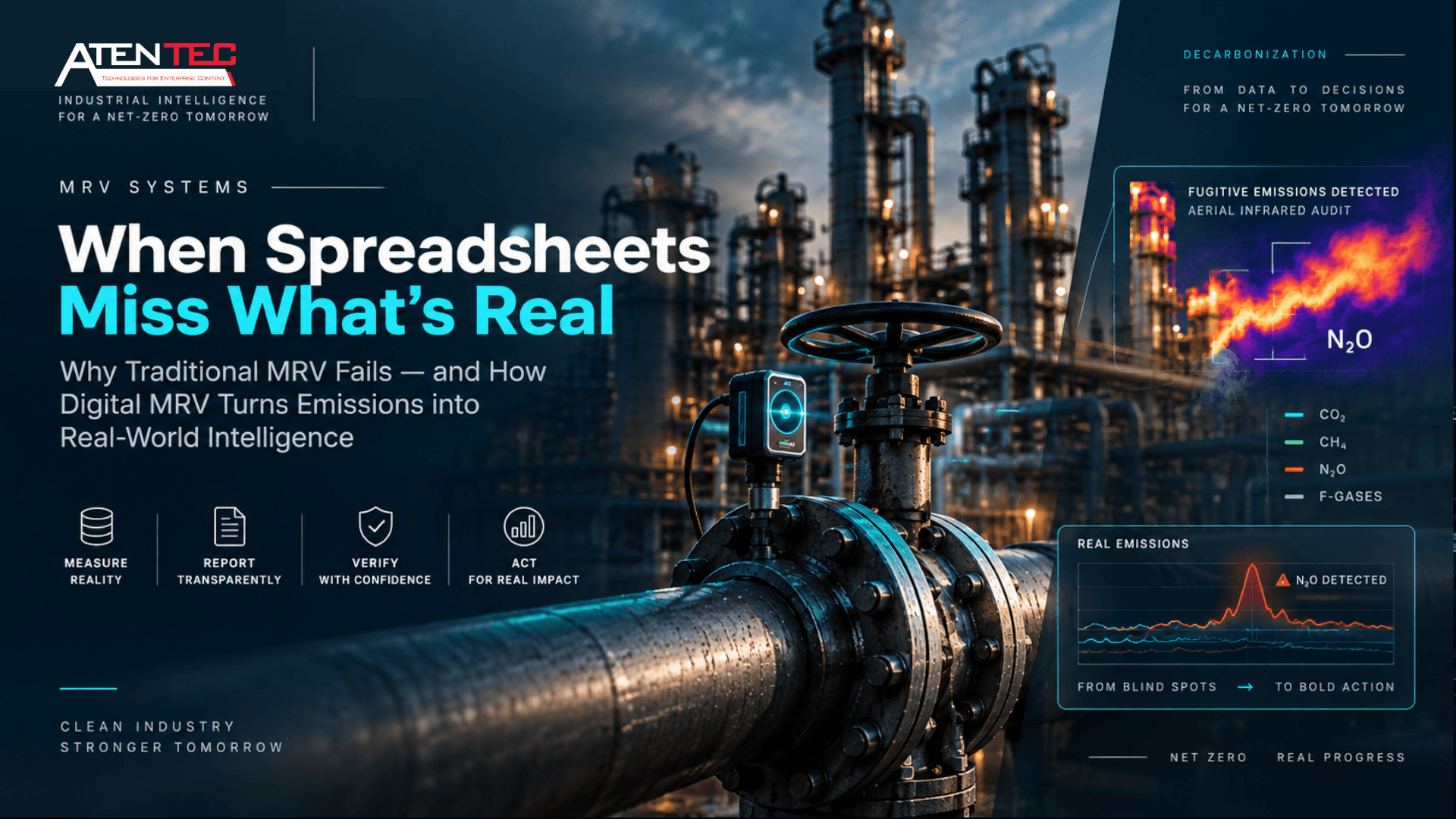
Carbon Accounting: A Data Interpretation Problem Disguised as Mathematics
What is Carbon accounting and where does it struggle?
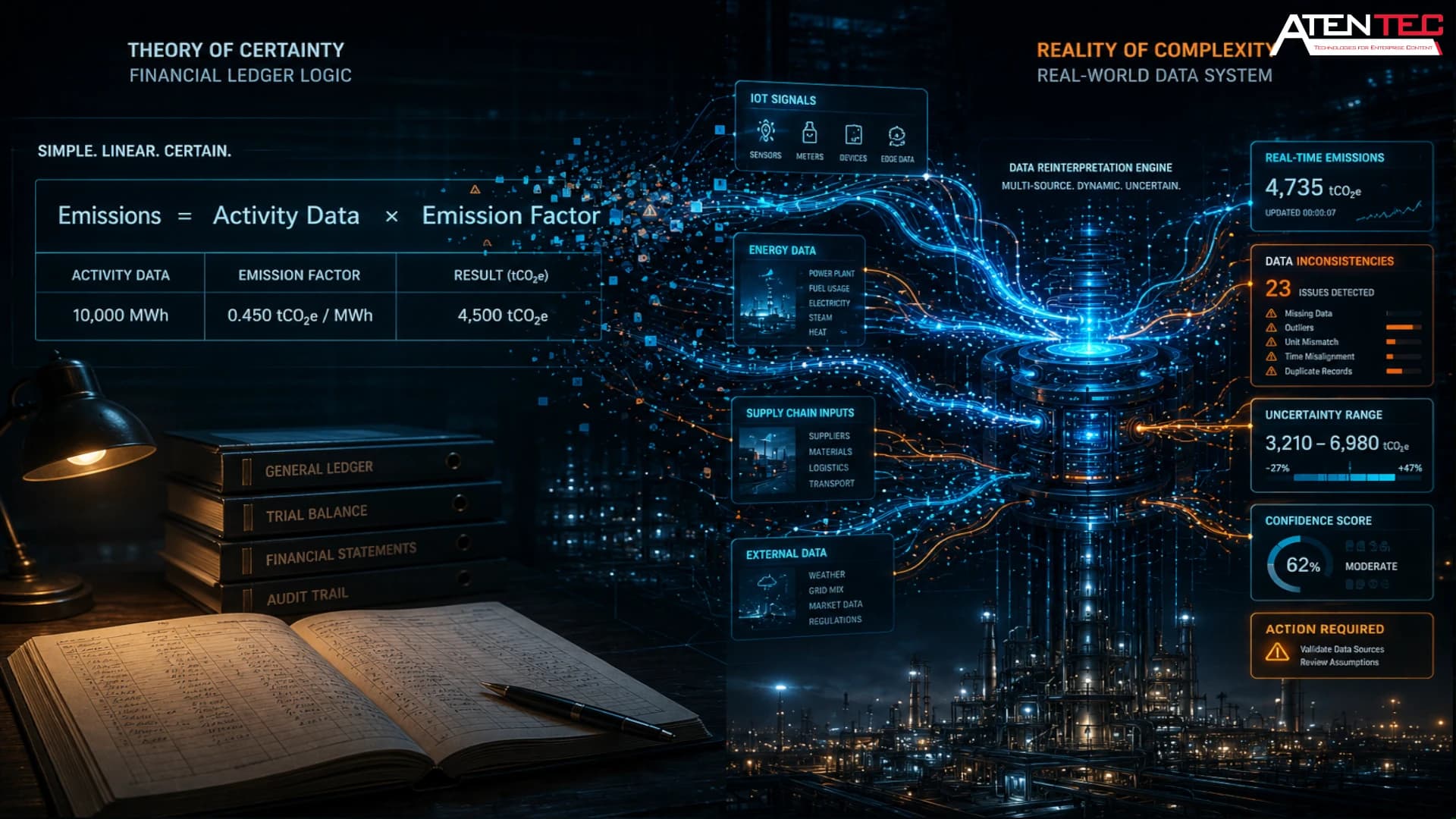
In the traditional corporate world, accounting is the language of certainty. Credits must equal debits, and balance sheets must reconcile to the last cent. However, when organizations attempt to apply this same linear logic to Carbon Accounting, they often encounter a chaotic reality that traditional financial systems are not built to handle.
The prevailing misconception is that carbon accounting is a simple arithmetic exercise:
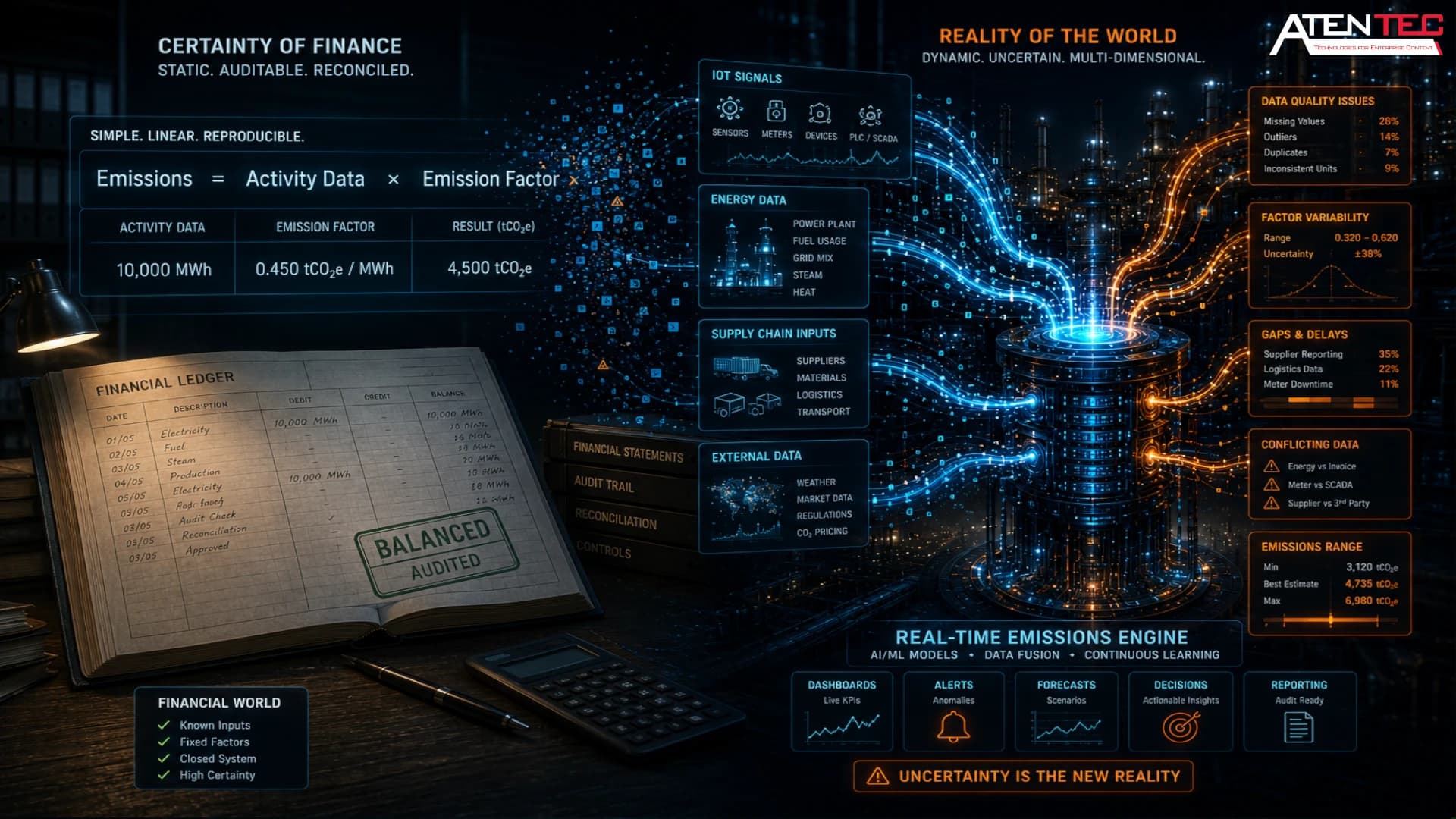
Activity Data X Emission Factor = Reported Emissions While this formula looks deterministic, it hides a massive layer of uncertainty, variability, and data fragmentation. Carbon accounting is not merely a mathematical output; it is a system of data interpretation under uncertain conditions. At AtenTEC, we believe that unless this process is treated as an industrial data system, it will lead to strategic misalignment and financial risk.
The Fragility of Activity Data: The "Garbage In, Garbage Out" Trap
The foundation of any carbon ledger is activity data—liters of fuel, kilowatt-hours of electricity, or tons of raw material. In theory, this data is readily available. In practice, it is often fragmented across disconnected silos: procurement spreadsheets, utility portals, and manual logs.
When data is collected manually or periodically, the "accounting" becomes a historical autopsy rather than a management tool.
Example 1: The Multi-Facility Industrial Gap
Consider a manufacturer with four plants across different regions. Plant A records fuel usage via automated meters, while Plant C relies on manually scanned invoices that are often late or incomplete. If the corporate carbon accounting team aggregates this data into a single quarterly report, the resulting "carbon balance sheet" is fundamentally skewed. The lack of a unified data pipeline means the company is making multi-million dollar ESG commitments based on a ledger that is $20\%$ estimation and $80\%$ historical guesswork.
The Emission Factor Fallacy: Why Averages are Dangerous
The second variable in the equation—the Emission Factor—is where most carbon accounting models fail. Most companies use national or industry-wide averages. While this is acceptable for basic compliance, it is disastrous for operational pricing and decision-making.
An emission factor is not a constant; it is a variable influenced by technology, geography, and time.
Example 2: The Green Energy Timing Paradox
An enterprise software company running high-intensity data centers might claim "carbon neutrality" by using an annual average emission factor for a renewable-heavy grid. However, if their peak processing loads occur at night when solar production is zero and the grid relies on gas-fired "peaker" plants, their actual carbon impact is significantly higher than their accounted impact.
Traditional carbon accounting ignores this temporal reality. An industrial data system, like the AtenTEC Emission Engine, integrates time-stamped grid intensity data, ensuring the ledger reflects the physical reality of the operation, not a convenient average.

Bridging the Gap: Engineering Reality vs. Financial Compliance
The real challenge of carbon accounting is that it requires a "double-entry" mindset that bridges two different worlds:
- The Engineering World: Dealing with thermodynamics, fuel chemistry, and sensor accuracy.
- The Finance World: Dealing with audit trails, regulatory compliance, and cost allocation.
Without a centralized technology layer, these two worlds never speak the same language. Engineers see a leak in a valve; accountants see a reporting line item. A robust carbon accounting system must translate that physical leak into a financial liability in real-time.
The Strategic Shift: From Reporting to "Carbon Intelligence"
Why does this distinction matter? Because as Carbon Taxes and CBAM (Carbon Border Adjustment Mechanism) become reality, your carbon ledger becomes a direct input into your product pricing.
If your carbon accounting is inaccurate:
- You may overpay: Paying taxes on emissions that you’ve actually reduced but couldn’t prove due to poor data.
- You may face penalties: Failing an audit because your "estimated" Scope 3 data couldn't be verified by a third party.
- You lose competitiveness: Competitors with better data systems can prove their products have lower "embedded carbon," allowing them to command a premium or bypass border tariffs.
How AtenTEC Emission Engine Redefines the Ledger
We don't just calculate numbers; we build an Audit-Proof Carbon Infrastructure. The AtenTEC Emission Engine transforms carbon accounting by:
- Automated Data Ingestion: Replacing manual spreadsheets with direct API and IoT feeds to eliminate human error.
- Dynamic Factor Management: Moving beyond static averages to localized, real-time emission factors.
- Scenario Modeling: Allowing you to run "What-If" scenarios on your ledger before you make procurement or investment decisions.
- High-Dimensional Decision Space: Managing the complexity of Scope 1, 2, and 3 emissions as interconnected variables, not isolated line items.

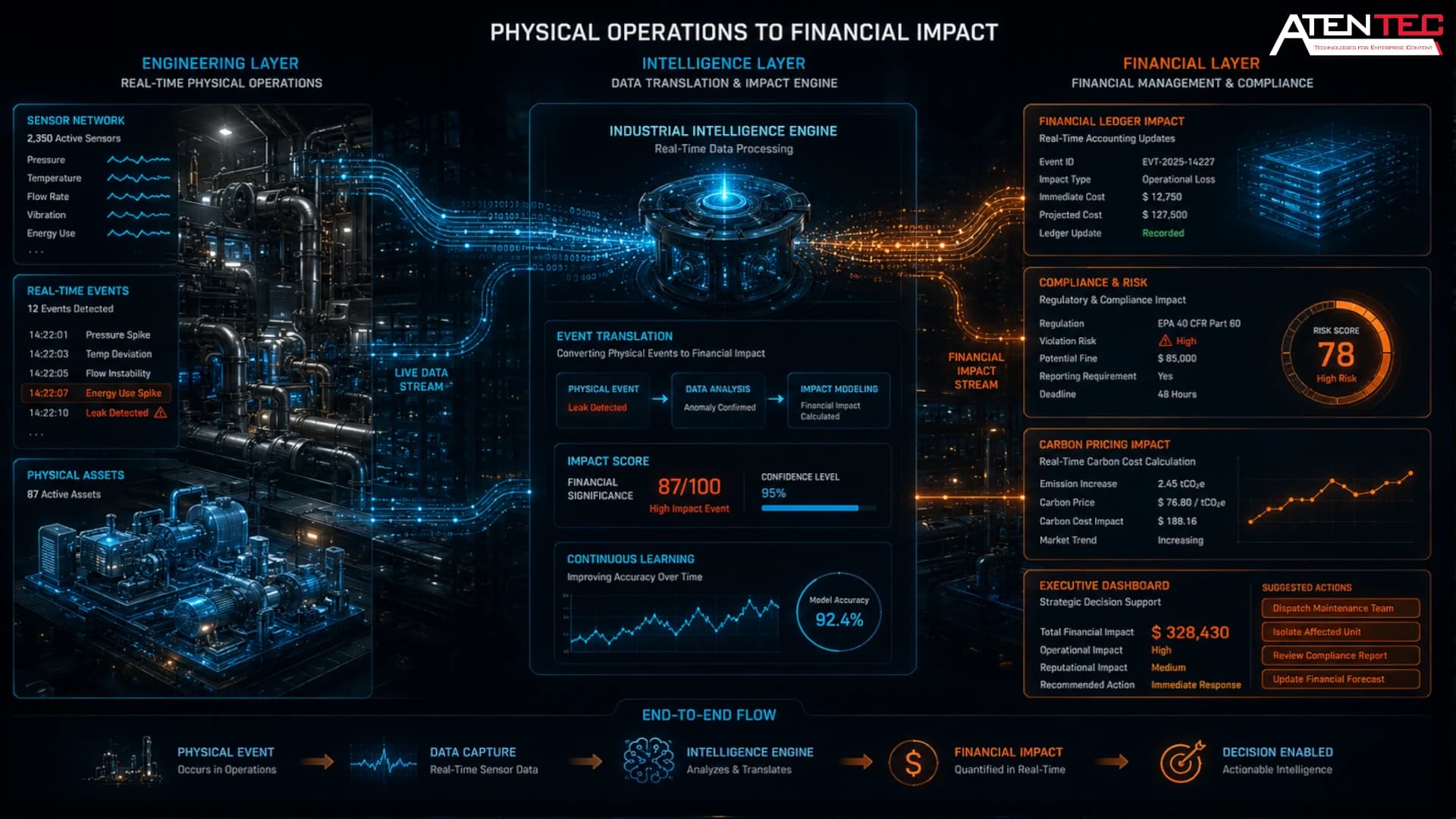
Carbon accounting is the bridge between your physical operations and your financial future.
If that bridge is built on top of fragmented data and simplified averages, it will not hold the weight of coming regulations.
To drive compliance and pricing effectively, your accounting must move beyond "reporting what happened" and start "explaining why it happened"—and how to change it. Because in the new carbon economy, the quality of your data is just as important as the quantity of your emissions.
What Comes Next
We have explored the footprint, the gases, and the accounting systems. But how do we measure the efficiency of our efforts?
In our final article of the Core Concepts pillar, we will tackle Carbon Intensity. We will explain why it is the single most important metric for decoupling business growth from environmental impact, and why it is the key to winning in a carbon-constrained market.
Explore More:
├── 1. Core Concepts (Read here) 👉 First Article: Content Series Overview
│ ├── carbon footprint (Read here) 👉 First Article: Carbon Footprint: The Number That Doesn’t Tell the Truth
│ ├── GHG emissions (Read here) 👉 Previous Article: GHG Emissions: Why CO₂ Is Not the Whole Story — and the Expensive Blind Spots You Are Missing
│ ├── carbon accounting 👉 (You are here)
│ └── carbon intensity 👉 Up next
- Our Methodology 👉 From Basic Concepts to Financial Impact.
“We turn carbon emissions into an industrial data system that drives compliance, pricing, and operational decisions.”
Because the real question is no longer:
How much do we emit?
But rather:
How do we use emissions data to drive better decisions?
,And that is where the real transformation begins.
Is your current system capturing your fugitive gases, or are you only seeing the CO₂? Discover how I-DNTITI turns molecular data into strategic pricing and compliance certainty.
"We turn carbon emissions into an industrial data system that drives compliance, pricing, and operational decisions."